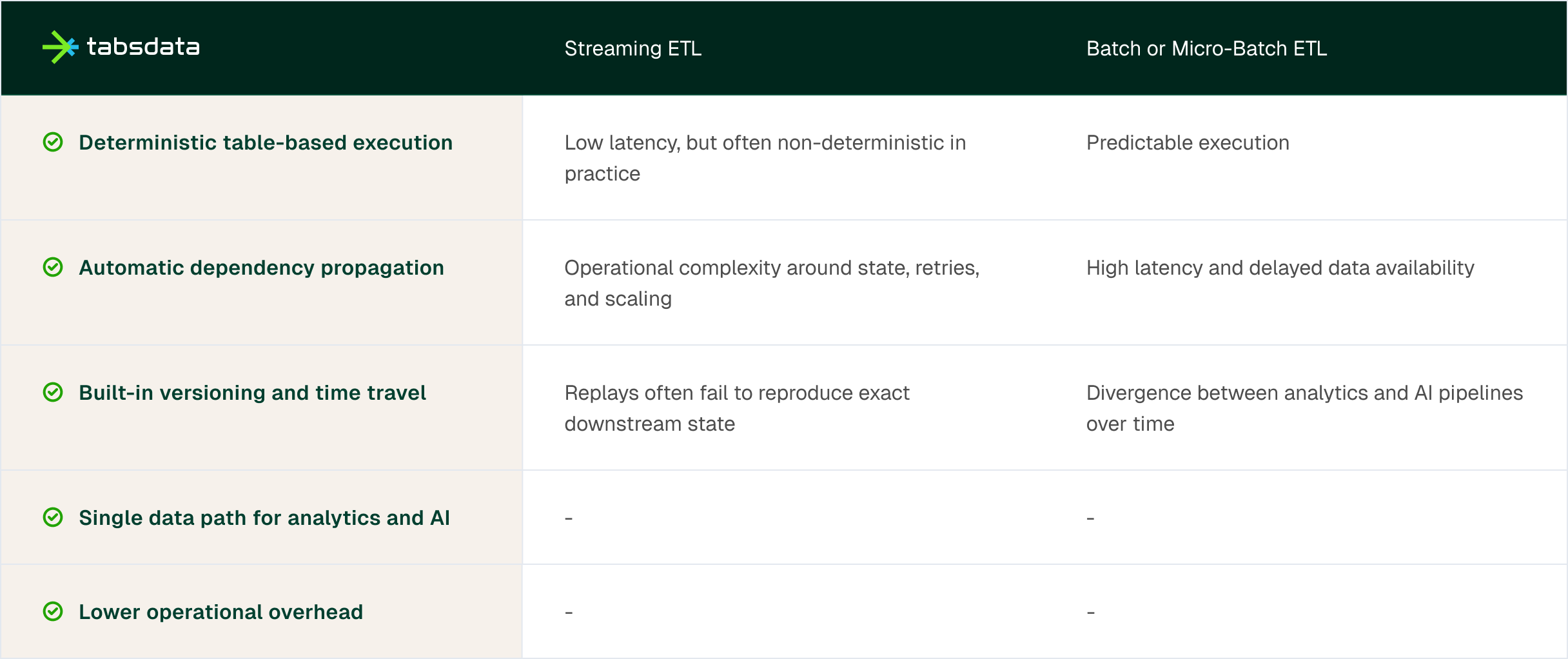
Deterministic execution
The same inputs always produce the same outputs across analytics and AI.
Tabsdata is a real-time ETL system designed for deterministic data propagation across analytics and AI workloads.
As soon as data is published, all declared downstream transformations are automatically executed. The result is a single, consistent data path where analytics and AI systems always operate on the same up-to-date data state.
This is real-time ETL built for correctness, not just speed.
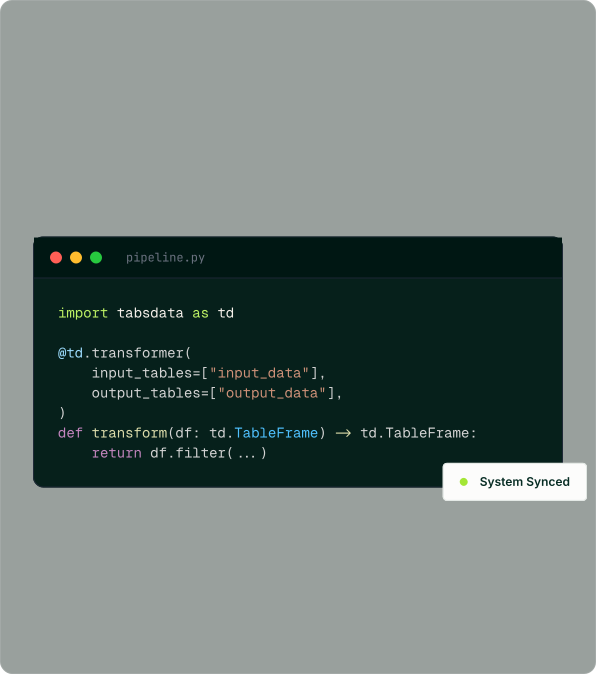


At the core of Tabsdata is a table-centric execution model called Pub/Sub for Tables.
Instead of orchestrating pipelines or managing streaming jobs, data producers publish tables. Transformations declare dependencies on those tables. When data is published, Tabsdata automatically evaluates and executes all dependent tables.
There are no schedulers, no user-defined DAGs, and no reconciliation between batch and streaming paths. Data propagation is deterministic, versioned, and reproducible by design.
Most systems frame real-time ETL as a latency problem. In practice, the harder problem is divergence.
As systems evolve, pipelines break, retries behave differently, and partial updates propagate unevenly. Over time, analytics dashboards, AI models, and downstream applications stop agreeing on what the data actually is.
Real-time ETL must ensure that all consumers see the same data state, derived through the same execution path, every time.
Delivering reliable real-time ETL at scale requires more than faster schedules or streaming infrastructure.
Effective systems must provide:
The same inputs always produce the same outputs across analytics and AI.

When data is published, all dependent transformations execute automatically without orchestration.

Analytics and AI systems consume the same versioned tables, eliminating training and inference drift.

Any historical data state can be reproduced exactly for debugging, audits, or model experiments.


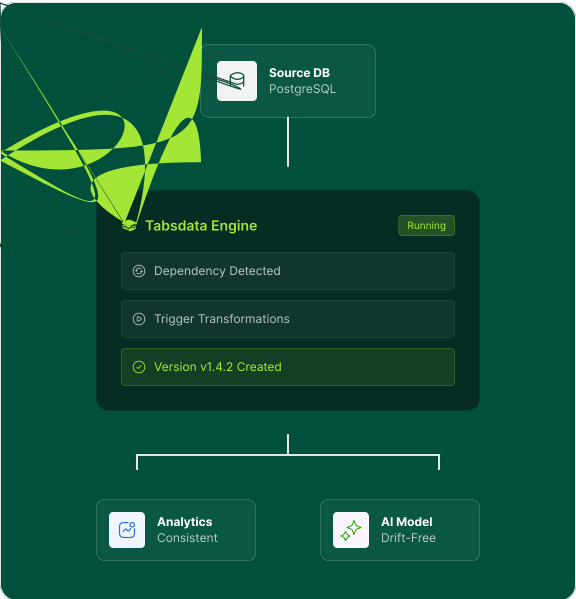
Tabsdata replaces pipeline orchestration with declarative data relationships.
When data is published:

All dependent tables are automatically updated
Each result is materialized as an immutable, versioned dataset
Lineage and metadata are preserved end-to-end
This execution model ensures that analytics and AI systems always consume the same consistent data versions, without timing gaps or reconciliation logic.
Because transformations are deterministic and versioned, teams can reproduce any historical state or reprocess data without disrupting live workloads.
Dashboards and models always operate on the same versioned data, eliminating discrepancies caused by timing or pipeline drift.
No external schedulers, no streaming orchestration, and fewer moving parts reduce operational burden and failure modes.
Immutable versions and time travel allow teams to debug, audit, and experiment without rerunning pipelines.
Lineage, metadata, and version history are captured automatically as data flows through the system, supporting governance and compliance without add-on tooling.
AI systems depend on fresh, consistent features.
When training data and inference data diverge, models degrade silently. Experiments become difficult to reproduce, and production behavior becomes harder to explain.
Tabsdata addresses this by ensuring:

Features are generated through the same deterministic data path for training and inference
Feature data stays current as new data is published
Historical feature sets can be recreated exactly using time travel
This makes it easier to train, validate, and deploy AI models with confidence, without maintaining separate feature delivery pipelines.
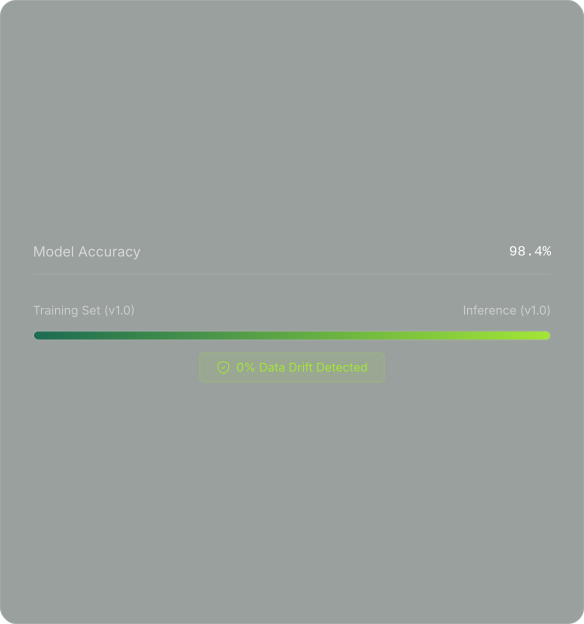

Tabsdata provides a simpler, more reliable approach to real-time ETL, grounded in deterministic execution and table-based data propagation.
Can’t find the answer you’re looking for? Please chat to our friendly team.