Real-Time Data Integration Solutions for Modern, AI-Driven Systems

Modern data systems are expected to operate continuously. Dashboards, applications, and AI models all depend on data that is fresh, consistent, and trustworthy at all times. Yet most data stacks were not designed to work this way. Tabsdata is a real-time ETL system built for always-on, AI-driven data environments. It replaces pipeline-heavy architectures with a declarative, table-centric execution model that keeps data continuously up to date, reproducible, and reliable across the organization.

The Real Problem: ETL Broke, and the Stack Compensated

Traditional ETL systems worked because they preserved meaning. Transformations were explicit, schemas were known, and producers and consumers stayed logically connected.

As data volumes grew and platforms shifted to schema-on-read, ETL gave way to ELT. Ingestion moved upstream, transformations were pushed downstream into orchestration DAGs, and data began flowing through layers without context.

Over time, the modern data stack compensated by adding:

Orchestration frameworks to manage execution

Data quality and observability tools to detect breakage

Semantic layers to reintroduce lost meaning

Streaming systems to improve freshness

Each layer solved a symptom. None fixed the execution model.

The result is complexity, drift, and systems that are difficult to reason about in real time.

What Real-Time Data Integration Actually Means

Real-time ETL is often confused with streaming ETL. They are not the same.

Streaming systems move events quickly, but they do not preserve state, semantics, or reproducibility. They optimize for transport, not for trustworthy data products.

Tabsdata defines real-time ETL differently:

Tables, not events

State, not messages

Deterministic propagation, not best-effort execution

When upstream data changes are published, downstream tables update automatically and consistently. Every update is versioned, traceable, and reproducible.

This is real-time ETL without orchestration sprawl or streaming complexity.
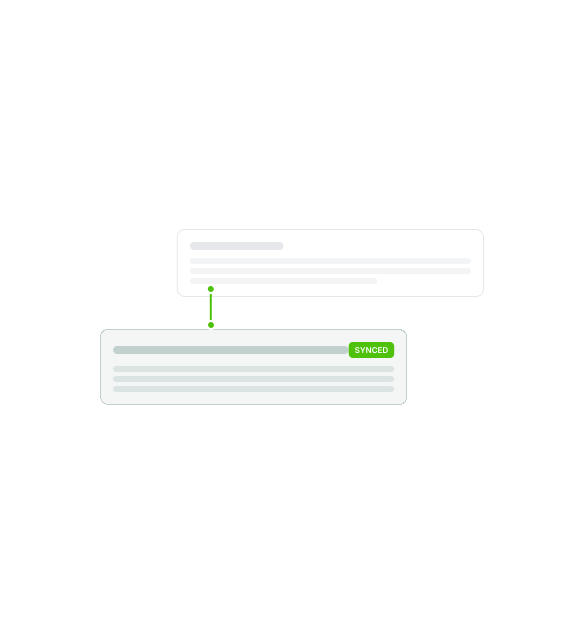
One Declarative Foundation for Real-Time Data

Tabsdata is built on a single, coherent execution model.

Using Pub/Sub for Tables, Tabsdata allows teams to define datasets and transformations declaratively. The system computes and maintains dependencies automatically and propagates changes in real time.

This foundation provides:

  • Continuous data freshness across batch, CDC, and real-time updates
  • Deterministic behavior across environments
  • Built-in lineage, metadata, and reproducibility
  • Preservation of semantics from producers to consumers

Everything else flows from this model.

Outcome Paths Built on Real-Time Data Integration

Tabsdata’s real-time Data Integration foundation enables multiple high-value outcomes without adding more tools or layers.

AI & ML Enablement

AI systems require features that are fresh, consistent, and reproducible. Tabsdata ensures training and inference pipelines stay aligned, supports time travel for experiments, and prevents silent drift as data changes.

Governance & Compliance

Governance depends on evidence. Tabsdata preserves immutable data versions, execution-native lineage, and full transformation context, enabling explainability and defensible audits for analytics and AI systems.

Legacy ETL modernization

Tabsdata restores the original ideas of Data Integration  while supporting real-time and modern architectures. Existing Data Integration logic maps naturally into declarative dataflows, enabling safe, incremental retirement of legacy platforms.

Why Teams Choose Tabsdata

Organizations adopt Tabsdata because it simplifies their data architecture while increasing confidence. Tabsdata removes the need for pipelines and other moving parts, making data propagation real-time, deterministic and fully traceable and auditable. Key benefits include:

Real-time freshness

Real-time data freshness without imperative pipelines and user-managed DAG executions

Deterministic execution

Outcomes are predictable, removing the need for guesswork.

Full fidelity traceability

Includes historical data and transformation code versions for fast debugging.

Built-in lineage

Provenance and fine-grained role-based access controls out of the box.

See Real-Time ETL in Action

Tabsdata replaces brittle, pipeline-driven architectures with a real-time ETL foundation you can rely on. See how declarative dataflows, automatic propagation, and reproducibility work together in practice.

Frequently asked questions

  • What is real-time ETL?

    Real-time ETL delivers data to downstream systems automatically as soon as it is published, without waiting for scheduled batch runs.

  • How is real-time ETL different from batch ETL?

    Batch ETL runs on a fixed schedule, often hourly or daily, pulling large volumes of data through pipelines that operate in discrete chunks. Real-time ETL processes data as soon as it becomes available, reducing the delay between when data is produced and when it can be used. Batch ETL is simpler but slower and prone to data inconsistencies and staleness, while real-time ETL keeps downstream systems fresher without waiting for scheduled jobs or large batch processing windows.

  • Why do enterprises need real-time ETL?

    Enterprises need real-time ETL because many decisions now depend on up-to-date operational data. Batch pipelines introduce inconsistencies and delays, causing dashboards to lag, ML features to drift, and business workflows to react too slowly. Real-time ETL reduces this latency by keeping downstream systems continuously current, which supports faster detection of issues, better customer experiences, and more reliable data for analytics, machine learning, and AI.

  • What are the main challenges with traditional ETL?

    Traditional ETL depends on scheduled batch jobs, which makes data slow to update and hard to keep consistent as systems change. Pipelines become brittle over time, breaking when schemas shift or new sources are added, and they require constant maintenance to stay reliable. Because each job runs in isolation, it’s difficult to trace lineage, manage dependencies, or guarantee that the downstream consumers see a consistent, up-to-date view of the data.

  • What are the main challenges with streaming pipelines?

    Streaming pipelines are powerful but difficult to build and operate at scale. They require specialized skills, constant tuning, and careful management of state, ordering and fault recovery. Small changes in schemas or data volumes can ripple into outages, and debugging issues across distributed components is slow and unpredictable. As they grow, these systems become costly to maintain, and many teams struggle to keep them accurate, reliable, and aligned with downstream consumers.

  • How does Tabsdata’s Pub/Sub for Tables model work?

    Tabsdata uses tables as the unit of data propagation. When an upstream table is updated, the platform automatically identifies which downstream tables depend on it and generates new versions for them. Transformations run on complete, consistent inputs, and Tabdata manages dependency tracking, ordering, and propagation without pipelines or orchestration. This keeps dataflows simple, reliable and fully reproducible.

  • How is Tabsdata different from other real-time ETL tools?

    Most real-time ETL tools rely on pipelines, jobs, and streaming engines to move data, which makes them complex to build and expensive to operate. Tabsdata takes a different approach: it uses tables as the unit of propagation, automatically updating downstream tables whenever upstream tables change. There are no DAGs, no orchestration layers, and no streaming infrastructure to maintain. Because all tables are versioned and consistent, Tabsdata delivers real-time data with built-in lineage, reproducibility, and far lower operational overhead than traditional real-time systems.

  • What sources and destinations does Tabsdata support?

    Tabsdata connects seamlessly to transactional databases, SaaS apps, APIs, log and IoT feeds, and delivers them to systems that require them. Tabsdata connects seamlessly to filesystems, object stores, databases, SaaS applications and specialized systems like message brokers and IoT systems. For a full list of systems that Tabsdata connects with, refer to the Publisher and Subscribers section of documentation available at docs.tabsdata.com.

  • How does Tabsdata handle data quality, lineage, and observability?

    Tabsdata evaluates every update through a system-generated execution plan. As each plan runs, Tabsdata records the exact table versions and transformation code used, creating a complete execution artifact. When the dataflow finishes successfully, that artifact becomes the table’s lineage, giving teams a precise and reproducible history of how each version was produced. Tabsdata also supports table-level quality checks that run automatically with every new version, with results stored alongside the table’s metadata for easy inspection and monitoring.

  • How long does it take to implement Tabsdata?

    Most teams can get started with Tabsdata in a matter of days, since the platform doesn’t require pipelines, orchestration setups, or bespoke streaming infrastructure. A small proof of concept usually involves connecting one or two sources, defining a few transformations, and publishing the outputs into your existing systems. Full implementation depends on the number of dataflows you want to migrate. Many teams roll out Tabsdata incrementally over a few weeks or months, expanding as they see value and gain confidence in the model.

  • How is Tabsdata priced?

    Tabsdata is priced per core of execution, grouped in 8 core increments. For more information, see the pricing page.

  • Can Tabsdata replace our existing ETL/streaming stack or work alongside it?

    Tabsdata can work alongside your current ETL and streaming systems or gradually replace parts that no longer meet your performance or maintenance needs. Most teams begin with workloads that need fresher data or are difficult to keep stable in pipelines or streaming engines. As they get comfortable with the model, many choose to simplify their stack by moving more dataflows into Tabsdata. Tabsdata works best for teams that value a declarative approach to dataflows and want the operational simplicity that comes from automatic dependency management and consistent, reproducible updates.

  • Still have questions?

    Can’t find the answer you’re looking for? Please chat to our friendly team.