Tabsdata + Databricks Integration for Deterministic, Real-Time Lakehouse Dataflows

Integrate Databricks with Tabsdata to build deterministic, real-time, versioned dataflows into Delta tables without orchestration or brittle pipelines. Using Pub/Sub for Tables, Tabsdata automatically propagates complete, immutable table versions into Databricks, ensuring Delta tables remain consistent and version-aligned.

About This Databricks Integration

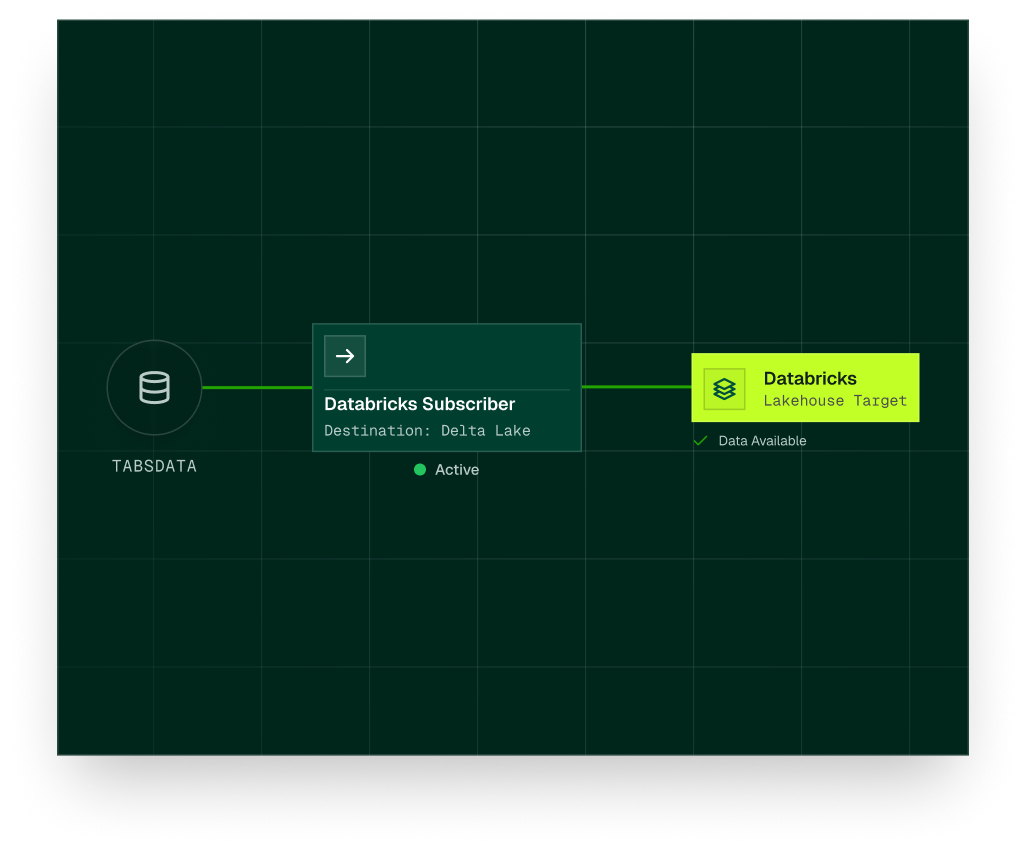
The Tabsdata + Databricks integration connects Tabsdata’s declarative dataflow engine with the Databricks Lakehouse Platform. Delta tables act as downstream subscribers within the Pub/Sub for Tables execution model, receiving new immutable table versions automatically as soon as they are published.

Rather than relying on scheduled ETL jobs or long-running streaming pipelines, table versions are automatically propagated based on declared dependencies. This ensures that data written into Databricks remains consistent, auditable, and aligned with upstream business logic, without partial refreshes or table state skew.

Key Capabilities of
Tabsdata + Databricks

These capabilities describe how deterministic execution, versioned tables, and dependency-based propagation work together to deliver reliable, real-time data preparation for Databricks without pipeline complexity.

Deterministic Data Propagation into Delta Tables

When new data is published, a fresh immutable table version is created and automatically propagated into Delta tables through declared dependency relationships. Propagation follows a deterministic execution order, ensuring related tables in Databricks always reflect a consistent data state.

Reproducible, Immutable Delta Table States

All Delta tables written by Tabsdata represent complete, immutable table versions. These versions preserve historical states by design, enabling reliable replay, debugging, recomputation, and time travel for analytics and AI workloads.

Automatic Lineage and Metadata Preservation

Lineage and metadata are captured natively as table versions propagate into Databricks. Because lineage is derived directly from table version relationships, it accurately reflects upstream inputs, transformations, and dependencies.

Installation

The Tabsdata + Databricks integration is installed via pip and configured using standard connection parameters. Delta tables can immediately participate as subscribers within versioned dataflows.

Install Package

Add the integration library to your environment.

$ pip install tabsdata-bigquery

Example Usage

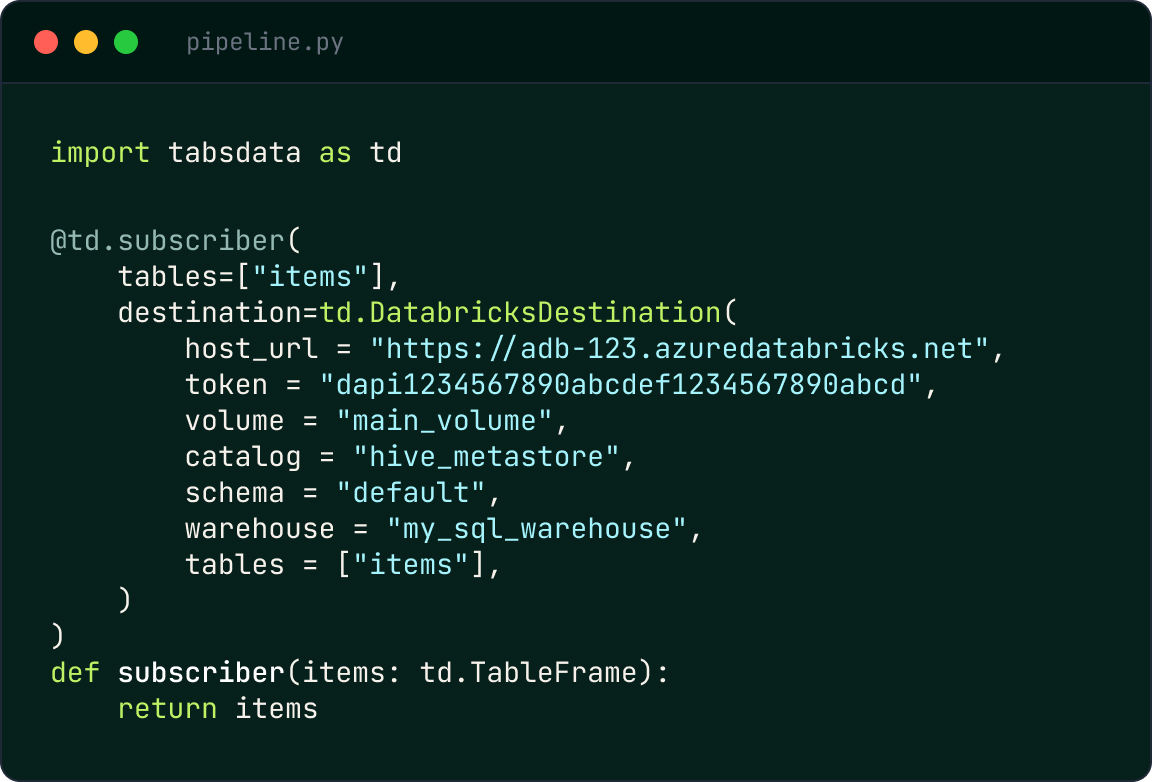
The following example shows how Tabsdata can publish a versioned table and propagate it into Databricks by subscribing a Delta table as a downstream destination. Once subscribed, Databricks automatically receives new table versions as data changes upstream.

Once this is configured, each new table version published in Tabsdata is propagated automatically into the Delta table. Updates remain deterministic and reproducible, with lineage and metadata preserved across the workflow, without scheduling, orchestration, or manual backfills.

Common Use Cases for Tabsdata + Databricks

The Tabsdata + Databricks integration supports a broad range of lakehouse workloads that require real-time updates, strong data consistency, and full traceability. These use cases show how versioned propagation and native lineage simplify complex Databricks pipelines.

Streaming Analytics Without Managing Streaming Jobs

Tabsdata keeps Delta tables continuously up to date without requiring teams to operate or manage long-running streaming jobs. Deterministic table version propagation ensures data freshness while preserving correctness and reproducibility.

ML Feature Stores With Real-Time Freshness

Machine learning workflows depend on timely and consistent feature data. Tabsdata ensures that feature tables propagate into Databricks as immutable versions, keeping training and inference pipelines aligned. Each of these updates is reproducible, reducing data drift and making experiments and model validation easier to audit and replay.

Data Quality & Governance Pipelines

Governance and data quality are built directly into Tabsdata’s execution model. As data flows into Databricks, lineage, metadata, and version history remain intact, supporting audits, quality checks, and policy enforcement. This strengthens lakehouse governance without relying on external lineage monitoring systems.

Financial & Operational Dashboards

Financial and operational reporting benefits from consistently fresh and reliable data. Tabsdata ensures Delta tables in Databricks reflect the latest business state through deterministic propagation. Dashboards update automatically as data changes, while historical versions remain available for reconciliation, analysis, and compliance reporting.

About Databricks

Databricks is a unified lakehouse platform that combines data engineering analytics and machine learning workflows. Built around Delta Lake, it provides ACID-compliant table storage with scalable performance for both batch and near real-time workloads, supporting data science and analytics use cases across cloud environments.

Start Using Tabsdata + Databricks

See how Tabsdata delivers real-time, lineage-rich, reproducible dataflows directly into your Databricks Lakehouse. Explore the documentation or request an integration review to evaluate how Tabsdata fits into your Databricks architecture.

Databricks Integrations FAQs

  • How does Tabsdata write to Delta tables?

    Tabsdata publishes immutable table versions and propagates them into Delta Lake tables as subscribed downstream destinations.

  • Can Tabsdata trigger updates to Databricks in real time?

    Yes. New table versions propagate automatically as upstream data changes, without schedules or polling.

  • Does it replace DLT pipelines?

    For many ingestion and data preparation pipelines, Tabsdata can reduce or eliminate reliance on DLT jobs by propagating complete, versioned table updates automatically.

  • How does Tabsdata handle schema evolution?

    Schema changes are captured as part of new table versions, schemas are preserved by table version and they are propagated

  • Does Tabsdata integrate with MLflow or feature stores?

    Tabsdata integrates at the data layer, providing versioned Delta tables that can be consumed by MLflow and feature store workflows.

  • Does Tabsdata require Databricks Structured Streaming?

    No. Tabsdata does not require Structured Streaming. Delta tables are kept current through deterministic table version propagation.

  • What are the infrastructure requirements?

    Tabsdata connects to  your existing Databricks-compatible cloud infrastructure without requiring additional streaming services.

  • Does the integration support Unity Catalog?

    Yes. Tabsdata writes directly to Unity Catalog–managed tables and respects catalog, schema, and permission boundaries.