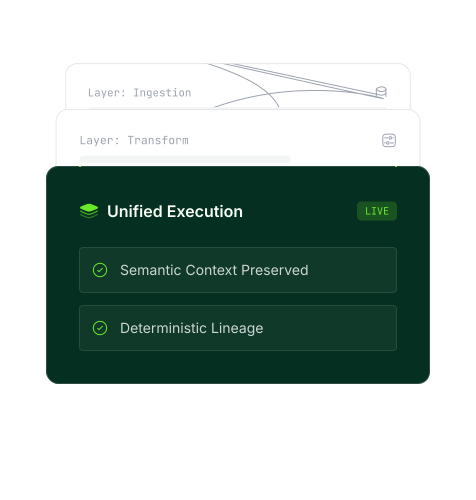

Transformations are explicit and deterministic.
Traditional ETL tools were designed around a simple but powerful premise - ingestion, transformation, and delivery were defined together. In platforms like Informatica and Talend, data mappings made it obvious where data originated, how it evolved, and where it was headed. This created trust because meaning and movement were inherently connected.
As data platforms evolved toward ELT pipelines, schema-on-read models, and orchestration-driven workflows, these responsibilities became distributed across tools. Ingestion, transformation, and delivery were decoupled, making end-to-end data flow more challenging to reason about. Lineage still existed in theory, but understanding it increasingly required stitching together metadata, logs, and downstream tooling.
Tabsdata modernizes ETL by restoring this end-to-end sensibility for real-time, cloud-native, and AI-driven systems. By bringing ingestion and transformation back into the data delivery lifecycle, Tabsdata makes data flow explicit - producers, consumers, and AI systems can trust not only the data itself, but its meaning and origin.
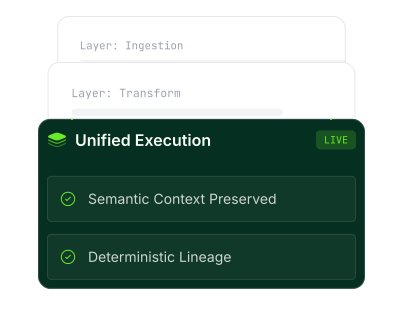

Classic ETL systems like Informatica, Talend, and Ab Initio were not flawed by design. They supported joins, aggregates, and rich transformations while preserving semantics, lineage, and ownership. These are symptoms of a deeper issue :
The shift to ELT changed the execution model:
Extraction and loading became decoupled from transformation.
Orchestration DAGs replaced integrated dataflows.
Raw data flowed through multiple layers without context.
Semantics and metadata were reintroduced downstream, imperfectly.
As a result:
Data quality tools emerged to catch inconsistencies.
Observability tools generated noisy alerts.
Semantic layers attempted to reconstruct meaning.
AI and ML pipelines suffered from drift and misalignment.
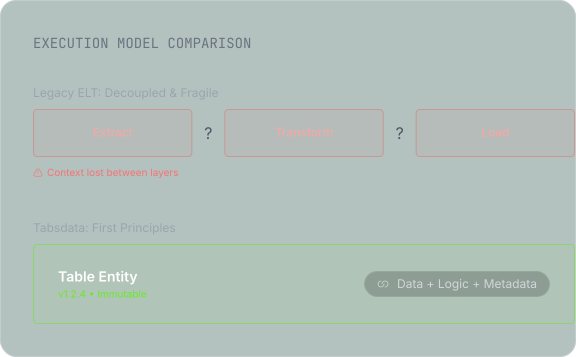
Tabsdata reintroduces the original strengths of ETL using a modern, declarative execution model.
Instead of passing data blindly through layers, Tabsdata treats datasets as first-class, versioned entities that publish changes and propagate meaning automatically.
Built on Pub/Sub for Tables, Tabsdata ensures:
Transformations are explicit and deterministic.

Semantics and metadata travel with the data.

Lineage is captured as part of execution.

Producers and consumers remain logically connected.
This restores the trust and clarity ETL once provided, without sacrificing real-time operation or scalability.
Because Tabsdata preserves the same conceptual model as traditional ETL, it maps naturally to existing systems.

Joins and aggregates map to declarative relationships
Scheduling logic is replaced by automatic propagation
Dependencies are computed and maintained by the system
Outputs remain consistent and reproducible
This allows organizations to retire grand-legacy ETL platforms incrementally, without redesigning downstream systems or rewriting business logic.
Migration is not a leap. It is a controlled transition.

Modern use cases demand freshness. Legacy ETL and ELT stacks often address this by adding streaming systems, micro-batches, and parallel pipelines.
Tabsdata removes this complexity.

Batch, CDC, and real-time updates are unified
Changes propagate deterministically as data arrives
Downstream systems always see consistent state
This enables real-time ETL without introducing streaming fragility or duplicated logic.
In traditional stacks, fixing logic or handling late data requires backfills, DAG rewrites, and risky coordination.
With Tabsdata:
Corrections trigger declarative recomputation
Historical versions are preserved immutably
Outputs update deterministically
Reprocessing becomes routine and safe, not a source of outages.
Input Stream
Consistent State

Data retains meaning across transformations instead of being reconstructed later.

Replace layers of orchestration, quality tooling, and semantic fixes with a single execution model.

Deterministic propagation ensures consistent outputs across teams and environments.

Feature pipelines remain aligned, reproducible, and explainable over time.

Lineage, ownership, and reproducibility are native, not bolted on.


Tabsdata does not ask you to abandon what worked in the past. It brings those strengths forward into a future-proof architecture designed for real-time data, AI workloads, and modern governance expectations.
Can’t find the answer you’re looking for? Please chat to our friendly team.