

New Integration

Tabsdata + BigQuery Integration for Real-Time, Consistent Dataflows

Integrate BigQuery with Tabsdata to build deterministic, real-time, versioned dataflows without pipeline orchestration or manual jobs. Using Pub/Sub for Tables, Tabsdata delivers consistent table updates with built-in lineage and reproducibility across analytics, machine learning, and operational BigQuery workloads.

About This BigQuery Integration

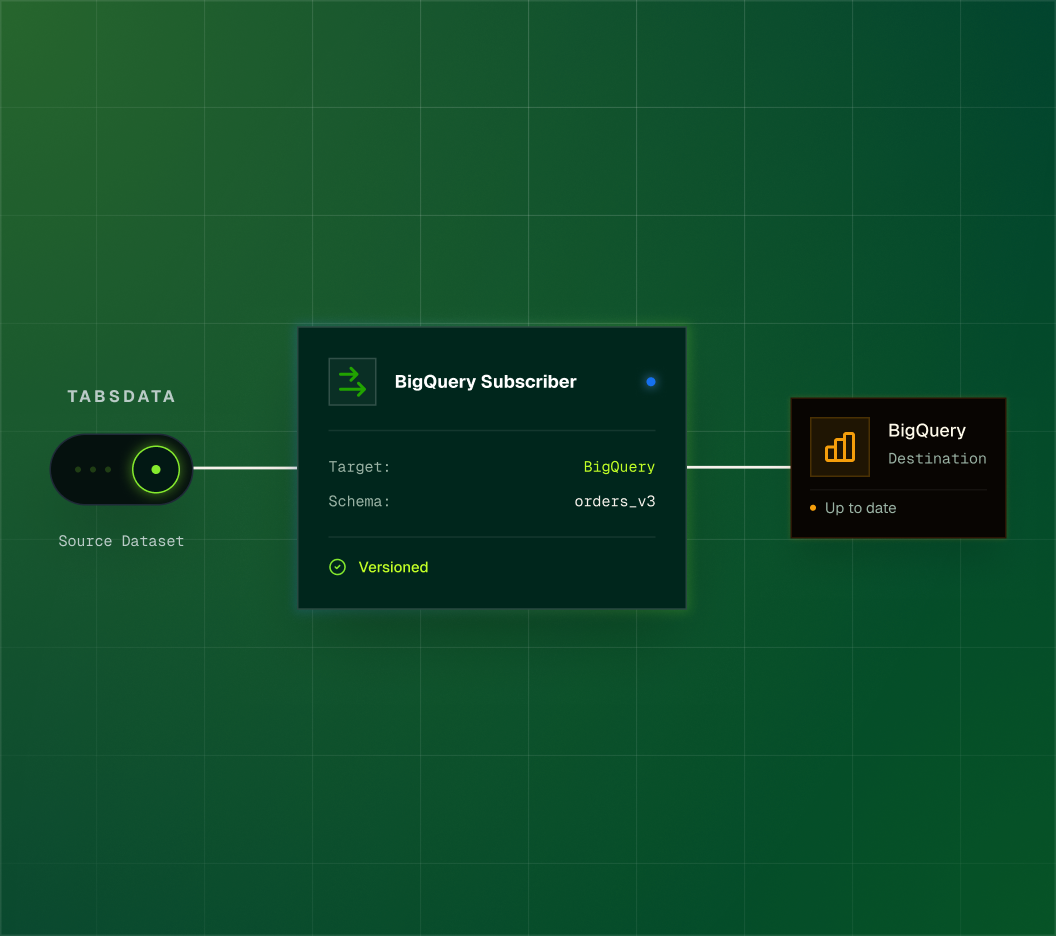
The Tabsdata + BigQuery integration enables native ingestion and delivery of datasets between Tabsdata and BigQuery. BigQuery tables act as downstream subscribers within Tabsdata’s Pub/Sub for Tables model, receiving new immutable table versions automatically as soon as they are published.

Instead of relying on scheduled pipelines or triggered jobs, updates propagate automatically based on declared table-level dependencies. Tabsdata preserves lineage, metadata, and reproducibility for every table version written into BigQuery, ensuring downstream consumers always operate on consistent, auditable data states.

Because BigQuery is a serverless platform, Tabsdata avoids orchestration patterns that trigger jobs or workflows. Table updates propagate deterministically as new versions are published, simplifying BigQuery dataflows while improving reliability at scale.

Key Capabilities of Tabsdata + BigQuery

Real-Time Deterministic BigQuery Table Updates

Tabsdata publishes changes as new immutable table versions and propagates them directly into BigQuery tables. Each publication produces a complete table version that is applied deterministically, ensuring analytics and downstream consumers operate on a consistent data state.

Automatic Propagation without Cloud Functions or Airflow

The integration eliminates the need for Cloud Functions, Composer, Airflow, or scheduled jobs. Execution order is derived from declared table dependencies, allowing updates to propagate automatically without triggers or workflow orchestration.

Works With Partitioned & Clustered Tables

Tabsdata integrates cleanly with partitioned and clustered BigQuery tables. Updates preserve partition boundaries and clustering strategies, ensuring performance characteristics remain stable as data volumes grow and tables evolve.

Immutable Versioning for Audits & Rollbacks

Each update delivered to BigQuery represents a complete, immutable table version. Historical states are preserved by design, enabling audits, debugging, rollbacks, and reproducible analytics or machine learning workflows without relying on external snapshots.

Native Lineage from Source → Transform → BigQuery

Lineage is generated directly from table version propagation as data flows from source to transformation and into BigQuery. Because lineage is inherent to execution, dependencies are accurately reflected without inference or post-processing.

Low-Latency Streaming Without BigQuery Streaming Costs

Tabsdata avoids cost-heavy BigQuery streaming buffer writes by propagating updates through efficient batch or microbatch pathways. This delivers low-latency updates while controlling costs and maintaining consistent, versioned table states.

Installation

Installing the Tabsdata + BigQuery integration is lightweight and developer-friendly. The connector can be installed directly using pip, with configuration handled through standard Google Cloud settings such as a service account, project ID, dataset, and target table.

$ pip install tabsdata-bigquery

Once configured, BigQuery can immediately participate as a destination for versioned dataflows managed by Tabsdata.

Example Usage

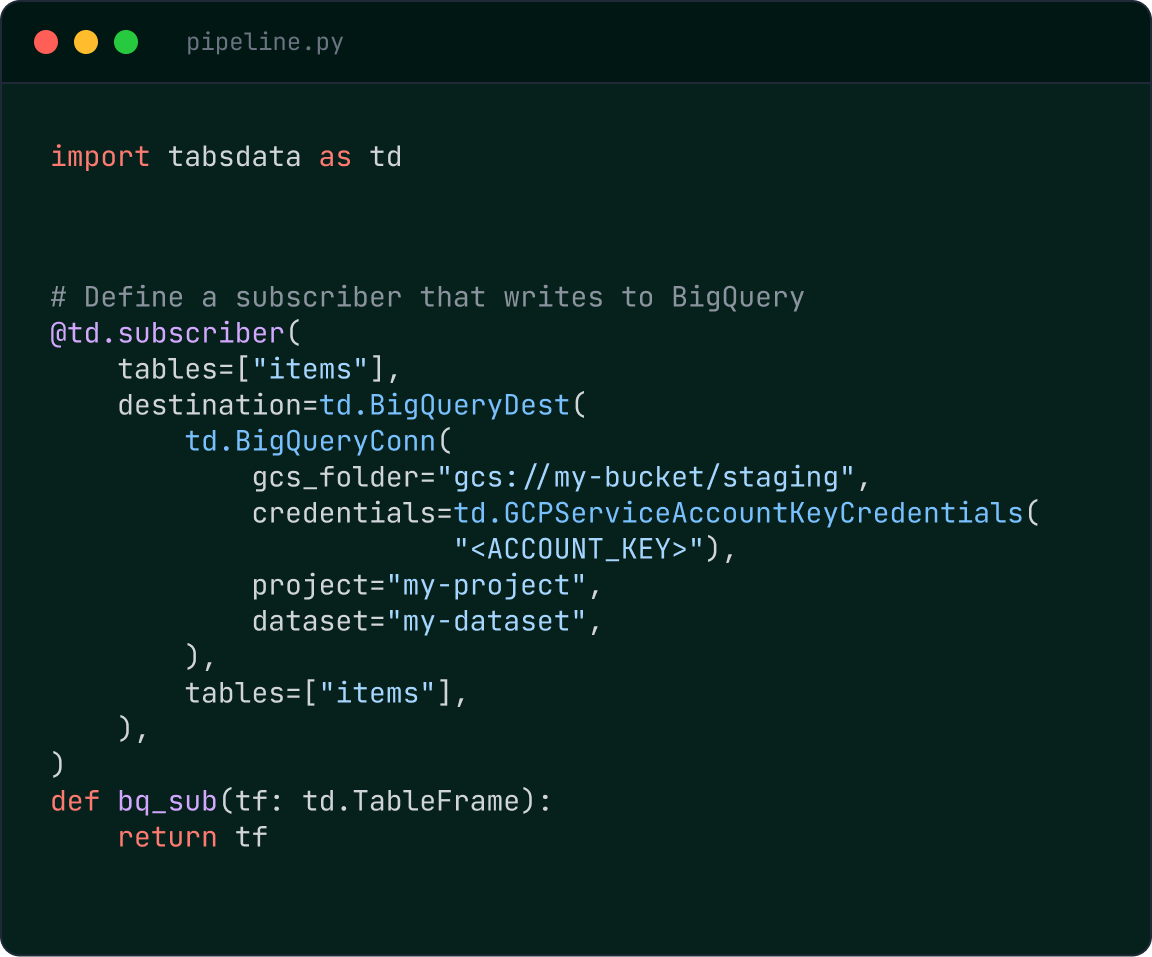
The following example demonstrates how Tabsdata publishes a versioned table and propagates it automatically into BigQuery as a downstream subscriber. Once subscribed, BigQuery receives new table versions as upstream data changes, without scheduling or orchestration.

Each published table version propagates deterministically into BigQuery, with lineage and metadata preserved for auditing, debugging, and reproducible analytics.

Common Use Cases for Tabsdata + BigQuery

The Tabsdata + BigQuery integration supports analytics, machine learning, and operational workloads that require fresh data, strong consistency, and full traceability without pipeline orchestration.

Real-Time Analytics in Looker or Looker Studio

Tabsdata keeps BigQuery tables up to date as new versions are published, allowing dashboards to reflect the latest data without cron jobs, refresh schedules, or manual pipeline management.

Machine Learning Pipelines Using BigQuery ML or Vertex AI

Versioned BigQuery tables provide reliable, reproducible inputs for BigQuery ML and Vertex AI workflow,s ensuring training and inference pipelines operate on consistent, auditable datasets.

Marketing, Product, or Operational Analytics

Tabsdata propagates updates automatically into BigQuery, enabling teams to analyze funnels, feature usage, operational metrics, or fraud signals using the most current published data.

IoT or Event Data Synchronization

High-volume event and telemetry data can be propagated into BigQuery as versioned tables, supporting large-scale analytics without managing streaming jobs or ingestion pipelines.

Governance & Compliance Pipelines

Built-in lineage and version history simplify audits and compliance reporting by making it easy to trace BigQuery datasets back to their upstream sources and transformations.

About BigQuery

BigQuery is Google Cloud’s fully managed, serverless data warehouse designed for large-scale analytics and machine learning. It supports SQL-based querying, partitioned and clustered storage, and high-performance analysis across batch and near real-time workloads without infrastructure management.

Start Using Tabsdata + BigQuery

See how Tabsdata delivers real-time lineage-backed dataflows directly into BigQuery without pipelines or orchestration. Explore the documentation or request a technical walkthrough to evaluate how Tabsdata fits into your BigQuery architecture.

Big Query Integrations FAQs

  • Does Tabsdata write to BigQuery in real time?

    Tabsdata propagates new immutable table versions into BigQuery automatically as soon as they are published.

  • Does this replace Airflow/Composer/Dataflow pipelines?

    For many ingestion and data preparation use cases, Tabsdata removes the need for orchestration by deriving execution order from table dependencies.

  • How does Tabsdata handle BigQuery partitioned tables?

    Tabsdata preserves partitioning and clustering while updating tables efficiently as new versions are published.

  • Can Tabsdata subscribe to BigQuery tables as a source?

    Yes. BigQuery tables can act as both sources and destinations within the same versioned dataflow.

  • Does lineage flow through to BigQuery?

    Yes. Lineage and metadata are preserved as part of table version propagation into BigQuery.

  • Does Tabsdata support BigQuery ML or training pipelines?

    Tabsdata provides fresh, reproducible table versions that can be consumed directly by BigQuery ML workflows.

  • What about schema evolution?

    Schema changes are captured as new table versions and propagated with metadata intact.

  • How does Tabsdata prevent BigQuery streaming cost spikes?

    Tabsdata avoids streaming buffer writes by using efficient batch or microbatch propagation paths.

  • Can BigQuery be both a source and a destination?

    Yes. BigQuery can publish data into Tabsdata and subscribe to downstream updates simultaneously.