One System — Full Context
Tabsdata is an agentic data engineering platform — one system where the agent sees everything, not an AI feature bolted onto a stack of disconnected tools. Every table is versioned, every execution produces its own lineage, and a living semantic catalog keeps meaning current as your data landscape changes. That's why data requests resolve in hours, not months: the agent never has to guess what exists, what it means, or what depends on it — and a human approves every change before it lands.
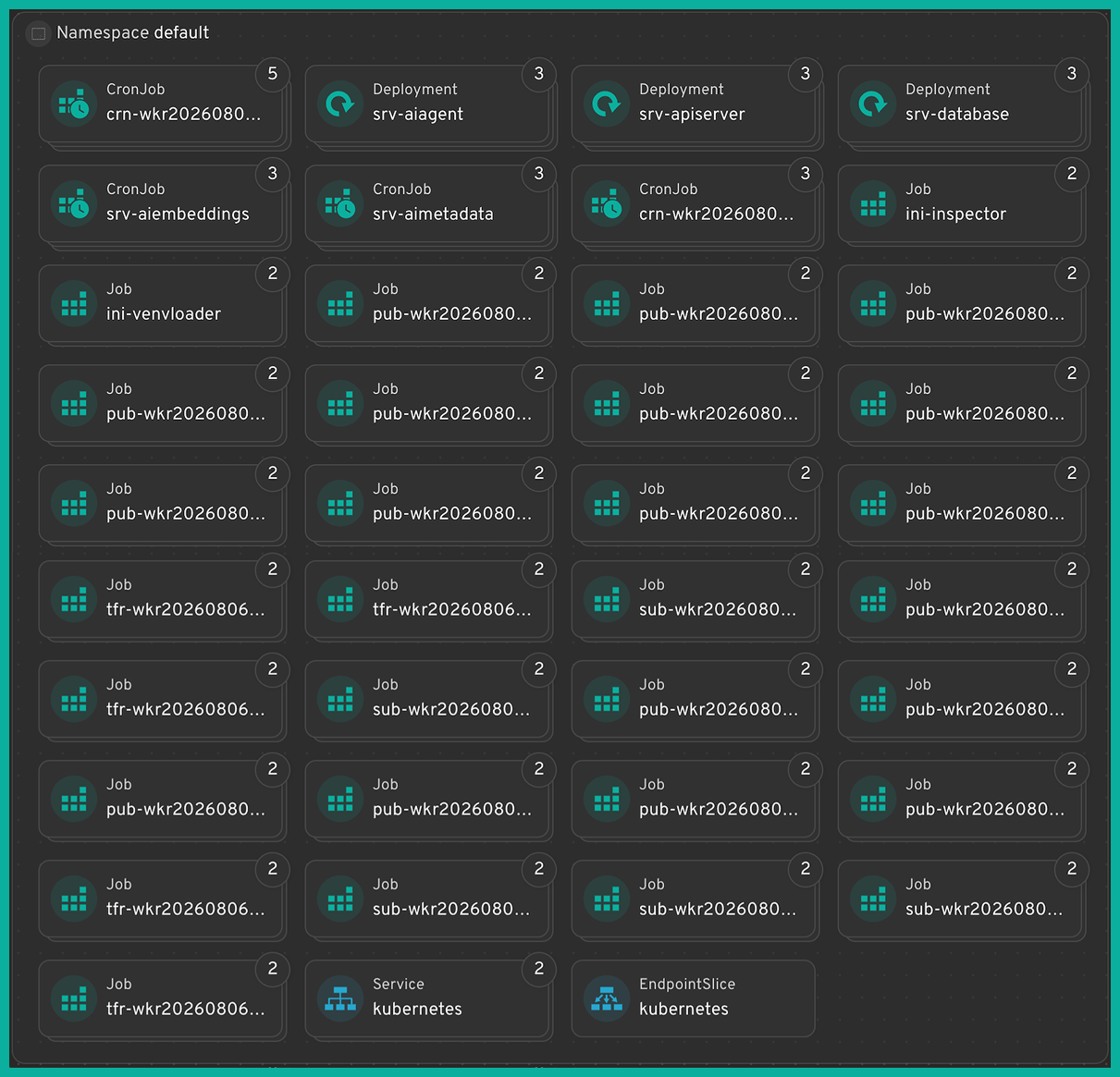

Context as Structure
Most stacks scatter context across tools — schemas in one place, jobs in another, meaning in someone's head. Tabsdata is built from four objects that carry their own context: everything the agent knows, the platform knows first.

The top-level container that groups related data flows. A Project gives the agent — and your team — a bounded scope: what belongs to this initiative, what it feeds, and where its edges are.

A Project is configured with source and destination connections — where data comes from and where it lands. Configuring one automatically creates its Source or Destination collection, the home for the functions that move that data, and immediately triggers the living semantic catalog. The moment data can flow, the system already knows what it is.

Where transformation lives: the functions and the tables they produce, versioned together. Every build in a Data Factory materializes incremental checkpoints, so validation happens as the dataflow takes shape — not after a big reveal.

Observational rollups across flows, feeding a live Sankey view of data moving through the system end to end. This is how a data leader sees the whole estate at a glance — what flows where, and what's healthy.
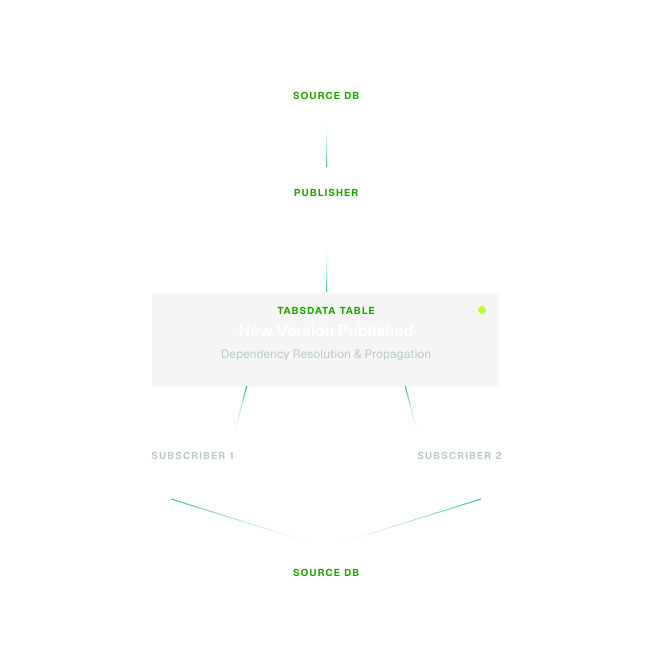
The Living Semantic Catalog
This is what gives the agent its context — built and kept current by the system itself, not by a committee. Discovery stops being weeks of hunting and asking around; it becomes a question the agent answers in seconds: what data do we have, and what does it mean?

Continuous metadata classification
Every source and destination is classified by LLM-driven analysis the moment it's connected — no manual curation, no ontology team, no six-month metadata project.
A live registry of every transformations and outputs
Every function, table, and materialized view is registered with its meaning and lineage — so "does this already exist?" is answered in seconds, before anything redundant gets built.
Always current, by construction
The catalog updates as your data landscape changes. It can't drift stale, because it's produced by the system itself — not maintained beside it.
Context served to any agent
Through Tabsdata MCP, the catalog is what your agent consults at the moment it acts: what data exists, what it means, and what depends on it.
Why it matters:
Industry analysts call the missing semantic layer the number one reason AI projects on enterprise data fail. Tabsdata's answer: make the semantic layer a living byproduct of using the platform — not a separate program of work.
Tabby — Eyes on Everything
Tabby is Tabsdata's built-in operational agent: it watches everything and changes nothing. It monitors your dataflows continuously, and when something goes wrong it does the investigation an engineer would: traces the failure through the lineage graph, identifies the root cause, and presents a suggested fix. What it never does is act on its own — Tabby is advisory by design. Every fix is a proposal; a human approves it. That's the difference between an agent that saves your team hours and an agent your team has to babysit.
Bring Your Own Agent
our agent of choice, one system underneath. Tabsdata doesn't ship a proprietary assistant and lock you into it — your data engineers connect the agent they already use — Claude, ChatGPT, Gemini, Copilot — through Tabsdata MCP. From there, the agent runs the full request lifecycle inside Tabsdata: it searches the living semantic catalog for what exists, checks for duplication before building anything, assembles the dataflow with incremental validation checkpoints, and runs regression against prior versions before anything lands. At every gate, a human approves. Any agent moves fast here, because the system beneath it was built to be seen — every table versioned, every execution traced, every definition current.


Sources and Destinations Across Your Stack
Tabsdata connects to the systems where your data lives and the systems where it needs to land — and delivers governed, versioned tables into the platforms you already run.
Sources

Destinations

See For Yourself
The fastest way to evaluate Tabsdata ins't a demo — it's a measurement. One workload, 30 days, your baseline versus ours.