Speed You Can Audit
Experience measurable compression at every stage of the request lifecycle, from discovery, duplication checks, build, and testing.
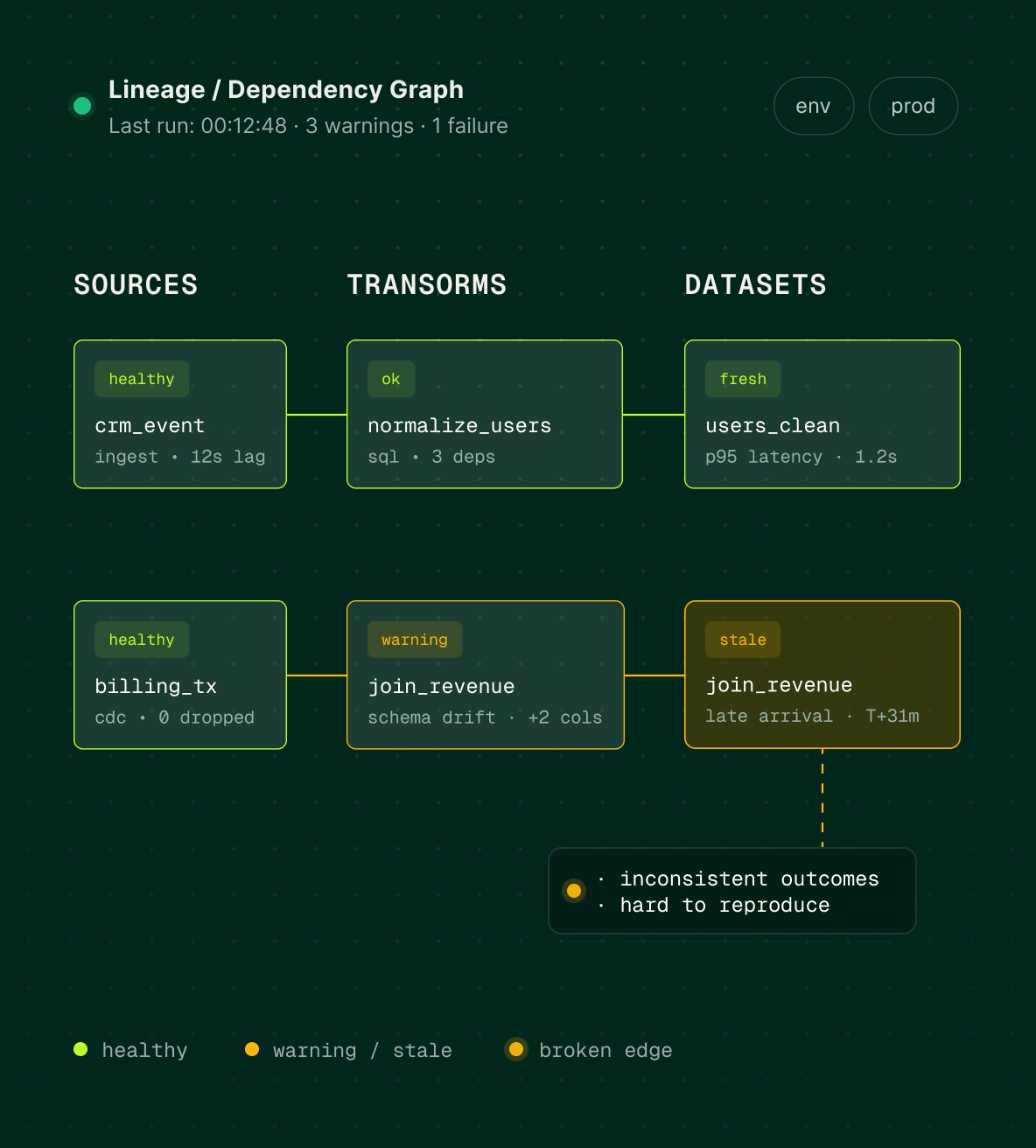
Discovery, build, validation, and testing run 99% faster on Tabsdata, the first truly agentic data engineering platform.
Works with the stack you already run
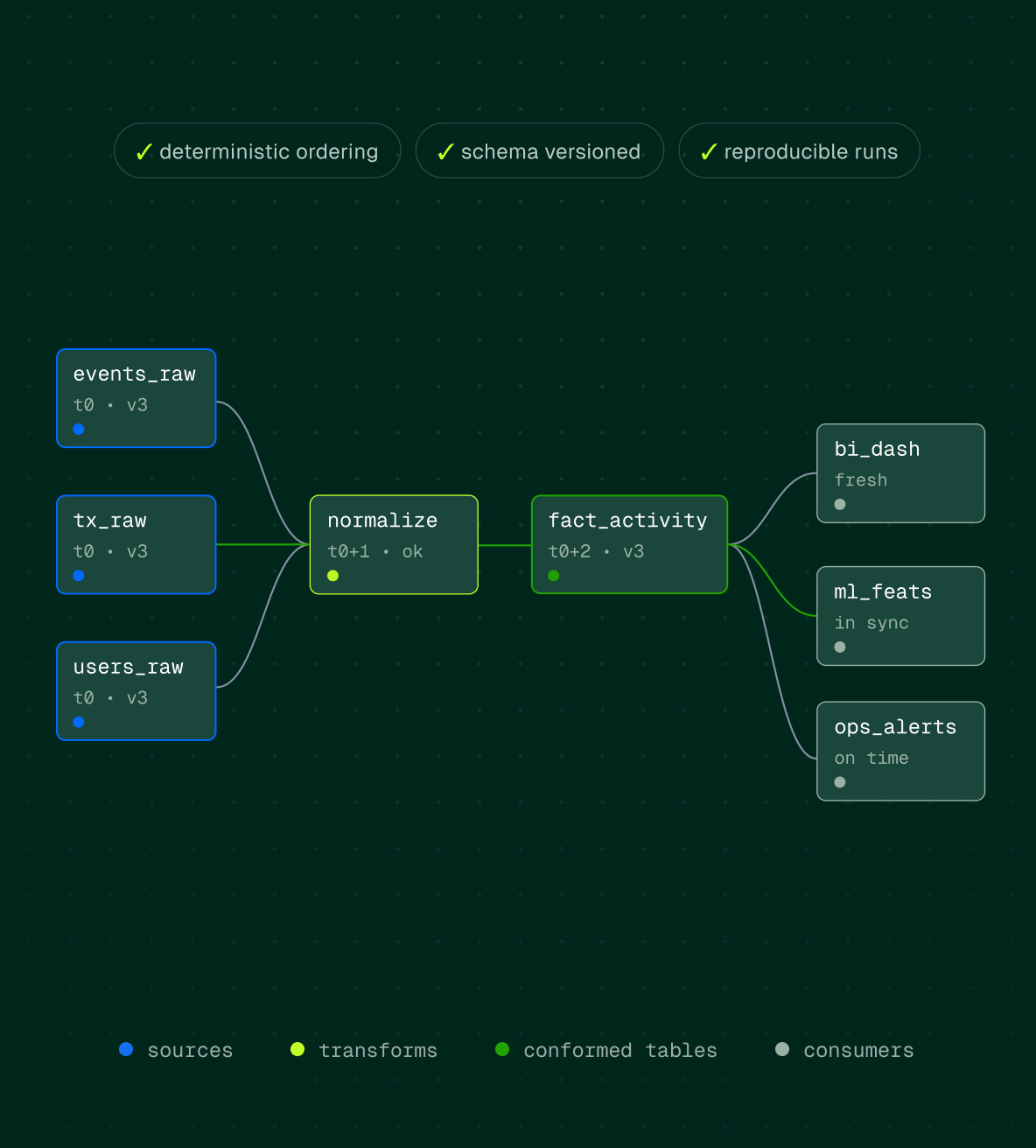
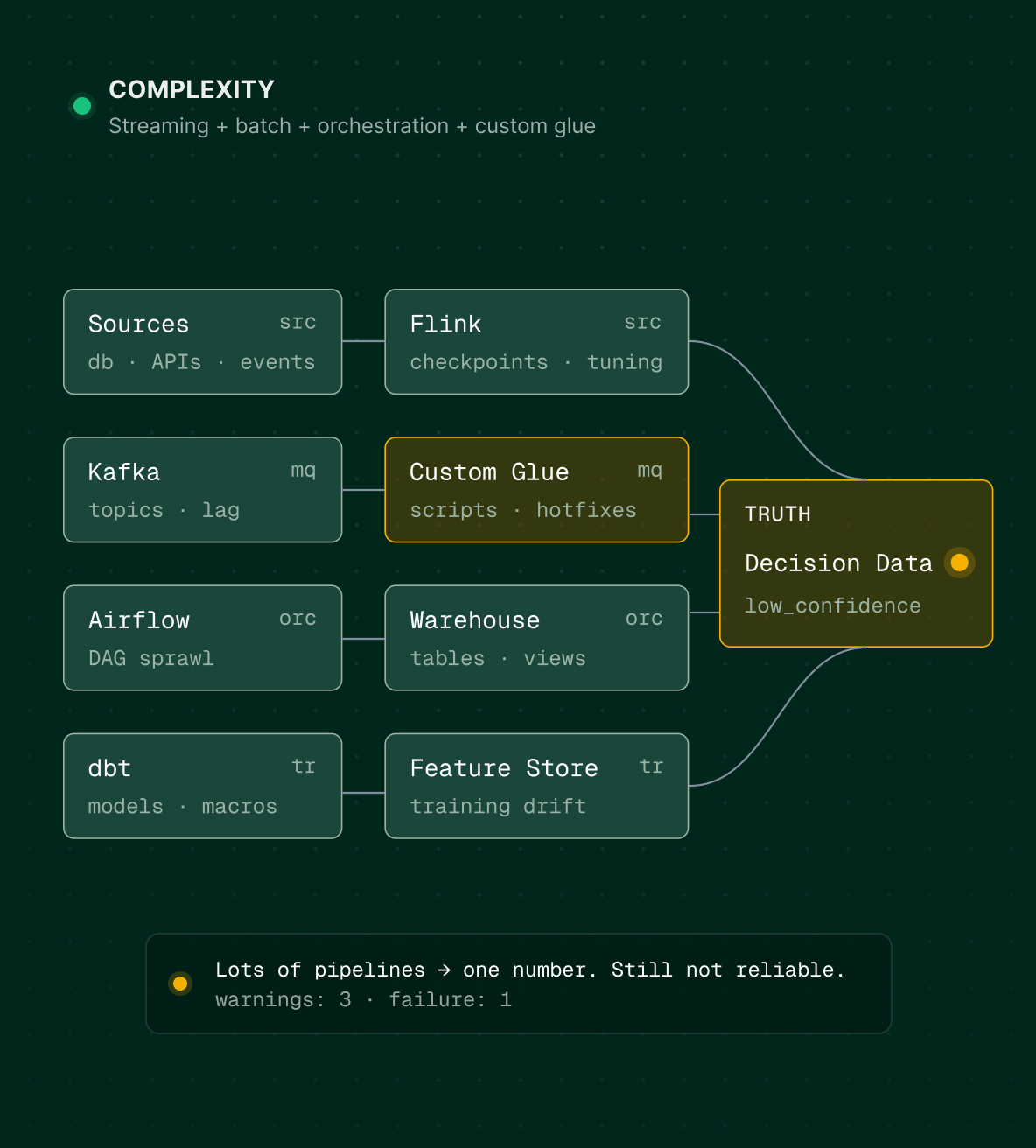
Every data platform is bolting on agents, and agents stitched across disconnected tools can't see the lineage, semantics, or dependencies that live in the systems around it. Tabsdata was built the other way around: as one system where your agent sees every table, version, dependency, and definition; all kept current by a living semantic catalog that classifies data the moment it connects. That's what makes it fast and safe.

Experience measurable compression at every stage of the request lifecycle, from discovery, duplication checks, build, and testing.
Versioned immutable tables, automatically generated lineage, downstream change validation, and so much more. Move fast with confidence. Plug in your favorite AI agent for full observability.
Whether your source of truth is Snowflake, Databricks, GCP, AWS, or Azure, Tabsdata seamlessly integrates beside your data platform of choice and delivers governed, versioned tables without impacting existing workloads or tools.
Tabsdata's living semantic catalog discovers and classifies every source and destination the moment it's connected to Tabsdata. As dataflows are built, it records their state, so delivered work becomes a discoverable and reusable building block for your next request.
Tabsdata's living semantic catalog discovers and classifies every source and destination the moment it's connected to Tabsdata. As dataflows are built, it records their state, so delivered work becomes a discoverable and reusable building block for your next request.
publish my customer and payment data from postgres
Redundant pipelines are the silent tax on every data team. Before building anything, the agent checks whether the answer already exists among prior deliveries.
customers is already published from Postgres, so I'll reuse it and only build a new publisher for the payment data.
The agent assembles your dataflow in stages, with intermediate steps captured as immutable, versioned tables that the requestor can inspect directly. Configure data quality checks to validate your data in real time.
now set it up as medallion, with a gold table for revenue by customer, and flag any customers with no revenue
That's 1 publisher for bronze, 2 transformers for silver and 1 for gold, with a quality check that copies customers with no revenue to their own table. I'll build it one layer at a time, and each step lands as a table you can open:
Regression testing is built-in. With full access to your workflow's lineage, any change to workflow logic is tested against prior versions of your data before it is applied.
modify the logic to exclude refunds
| customer | v1 | v2 |
|---|---|---|
| Acme Co | $48,210 | $48,210 |
| Northwind | $31,900 | $29,450 |
| Globex | $27,340 | $27,340 |
| Initech | $19,800 | $18,920 |
22 of 4,812 customers changed, all ones with refunds. Everything else matches v1.
Publishers read data from anywhere and write it into versioned Tabsdata tables.
Create a publisher that reads the orders table from Postgres into a table called orders.
from tabsdatak.api import TableFrameSpec, publisherfrom tabsdatak.conn.postgres import PostgresSrc @publisher( source=PostgresSrc(queries=["SELECT * FROM orders"]), output_tables=["orders"],)def pub_orders(orders: TableFrameSpec) -> TableFrameSpec: return ordersYour backlog is the most visible number in the company. Tabsdata changes the unit of measure for request resolution from weeks to hours. Move fast without compromising on governance with full lineage and observability built right into the tool.
Tabsdata works with you and handles the boilerplate like schema discovery, duplication checks, and data validation so you can focus on the things that matter. Spend less time in the ticket queue and more time on the work that needs an engineer.
Tabsdata deploys in your cloud, hybrid, or fully on-premises.
Tabsdata runs on Kubernetes and may be deployed on self-managed Kubernetes clusters or public cloud Kubernetes services including serverless infrastructure.
Tabsdata can be deployed on bare metal infrastructure and can run on development laptops and workstations.
$ tdkserver quickstartSee how much faster your team can resolve data requests with Tabsdata. Pick a workflow and we'll show you the difference in 30 days.
Tabsdata is an agentic data engineering platform that helps teams complete data requests in hours instead of months. By building the AI agent directly into the underlying data infrastructure, Tabsdata gives your agent full visibility into every table, version, dependency, and definition. Tabsdata can handle everything from finding the right data to use for a data request, planning and architecting the steps needed to solve a problem, building and testing your workflows, and debugging errors.
The compression happens at every stage of the lifecycle. Discovery is near-instant because a living semantic catalog classifies data as connections are created. Duplication is caught before anything is built. Builds are validated incrementally with materialized checkpoints. Regression testing is native because every table version and execution is recorded.
In Tabsdata, the agent never mutates data. This is because every change an agent makes creates a new immutable version of your data, making lineage an intrinsic part of your workflow. Any change made to your data can easily be rolled back.
The living semantic catalog is what gives the agent its context. When a source or destination is connected, Tabsdata automatically classifies its metadata using LLM-driven analysis and stores that data to the catalog. Tabsdata then continuously records the state of every dataflow you build in Tabsdata. Armed with a full view of your data stack, Tabsdata can make smart decisions in building your workflows, ensuring already delivered work is discoverable for the next request.
Bring a workload of your choice and a baseline for its current time-to-resolution. Within 30 days, we'll deliver a working dataflow for your use case in Tabsdata, complete with full data lineage. We guarantee measurable improvements in both time-to-resolution and performance.
Tabsdata is free for self-supported deployments. This includes the full platform, including the agent, the living semantic catalog, and lineage. Paid contracts add 24/7 support and full indemnification.
Agentic data engineering is the use of AI agents to carry out data engineering work end to end. This includes finding the right data, checking for existing solutions, building dataflows, and testing changes. Most implementations bolt an agent onto a stack of disconnected tools. Tabsdata's approach is different: the agent operates inside a single system that natively tracks lineage, versions, and semantics, allowing it to act with full context.
Warehouse-native agents are limited to their own platform and lack visibility into data outside of it. This presents a problem since most real dataflows cross several tools. Tabsdata is a data engineering system designed so the agent sees the entire flow end to end, with full access to the state of your entire data stack.
No. Your data warehouse, whether it's Snowflake, Databricks, GCP, AWS, or Azure, remains the center of your storage, compute, and analytics. Tabsdata sits alongside your existing infrastructure, allowing you to shift-left the data request lifecycle before delivering governed, versioned tables directly into your warehouse.
It can, but it is not a requirement. Tabsdata can be implemented without impacting existing workloads and the tools that run them. However, several data engineering tools often need to be stitched together to achieve all the features that Tabsdata offers such as data ingestion, transformation, orchestration, and observability. Simplifying the overhead of several tools with Tabsdata is one reason Tabsdata users see 99% faster request resolution.
Tabsdata can be deployed in your cloud using Kubernetes services like AKS, GKE, or EKS, in a hybrid environment, or fully on-premises. You can even run Tabsdata locally on your laptop or workstation.