Safe By Construction
An agent is only as trustworthy as the system beneath it. Tabsdata's architecture — versioned immutable tables, execution-native lineage, deterministic propagation — was built so an agent can move fast without being able to break what it can't see.
Pub/Sub for Tables
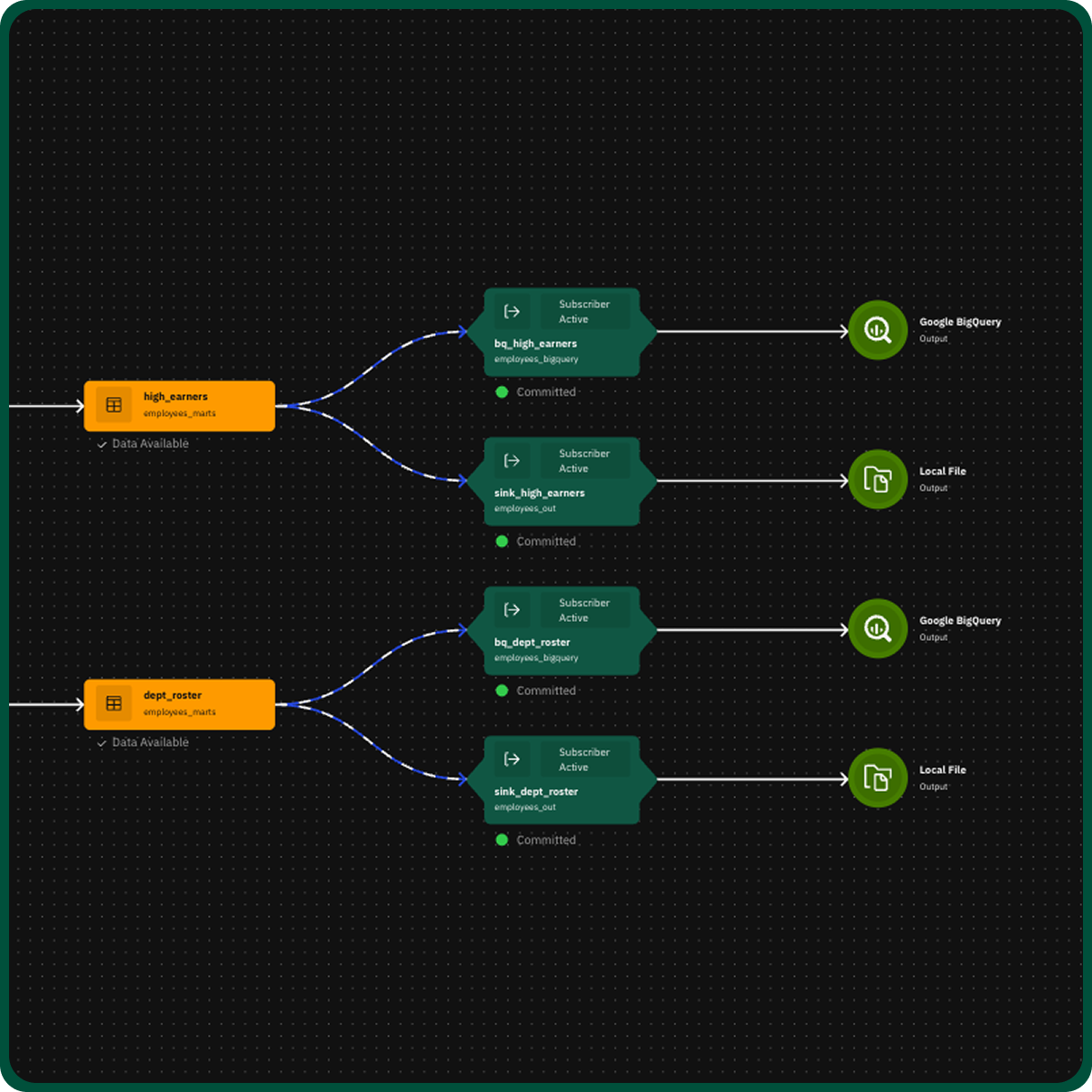
In Tabsdata, the table is the unit everything moves in. Functions publish tables into the system, transform tables into new tables, and subscribe tables out to their destinations. When a table gets a new version, everything that depends on it updates deterministically — no orchestration DAGs to maintain, no scheduler glue, no pipeline code whose only job is moving data between tools. Propagation isn't something you build; it's what the system does.
Nothing Overwritten, Nothing Lost
Every write in Tabsdata creates a new immutable version of a table. Nothing mutates; nothing is destroyed. That one property does a surprising amount of work: time travel to any prior state, exact reproducibility of any past result, safe reprocessing without fear of corrupting downstream state, and rollback that's a pointer move rather than a recovery project. It's also the property that makes agent mistakes survivable by definition — the worst an agent can do is create a bad version, which a human declines.
Execution-Native Lineage
Most lineage tools work backwards — parsing logs and SQL after the fact to guess how data moved. Tabsdata's lineage is the execution record itself: every table version is traceable to the exact input versions and the exact function code that produced it, because that's how the system runs. There's no drift between what the lineage says and what actually happened — they're the same artifact.
Quality as a Gate, Not an Alert
Most data quality tooling alerts after bad data has already propagated. Tabsdata's architecture inverts that. Dataflows are built with incremental validation — checkpoints surface problems while they're cheap to fix, not after a big reveal. Every change is regression-tested against prior versions before it lands. Unvalidated data never flows downstream: a bad result is a new version a human declines, not a contamination event. And when a source breaks, execution-native lineage makes root cause a lookup, not an investigation.
The Substrate is the Safety Model
Put these properties together and the agentic story stops being a leap of faith. The agent has full context at the moment it acts, because lineage and versions are native, not bolted on. Its blast radius is bounded, because every change is a new version and never a mutation. And human approval is enforceable, because a proposed change is a concrete, inspectable artifact — not a description of what the agent thinks it did. This is what "safe by construction, not by supervision" means: the guarantees come from the architecture, and they hold for any agent connected through Tabsdata MCP.

Wherever Your Data Lives
Tabsdata is Kubernetes-native and deploys wherever your data needs it to: on any public cloud, hybrid, or fully on-premises. Development starts on a laptop — pip install tabsdata — gives every engineer a complete local environment. The same system scales to production without changing shape.
Wherever it runs, your data never leaves your network. Role-based access control and full audit logging are part of the platform — and because every change is a version with a complete execution record, the audit trail isn't a log you configure; it's the system's memory.
Two Ways In
The full mechanics — table versioning, function model, propagation semantics — live in the docs. Or skip ahead and see it on your own workload.