Tabsdata + Salesforce Integration for Real-Time CRM Dataflows

Sync Salesforce data with Tabsdata to power deterministic, real- time, reproducible CRM dataflows without API-heavy pipelines or fragile sync jobs. Using Pub/Sub for Tables, Tabsdata keeps CRM data consistent, traceable, and version-aligned across analytics, operations, and downstream systems.

About This Salesforce Integration

The Tabsdata + Salesforce integration enables secure, API-based connectivity between Salesforce and Tabsdata, allowing CRM data to be published as reusable, versioned datasets. Both Salesforce reports and ad-hoc Salesforce SOQL queries can be ingested into Tabsdata, where each publication produces a new immutable table version.

Instead of relying on scheduled sync jobs, updates propagate automatically as soon as new table versions are published, based on declared table-level dependencies. This eliminates pipeline failures and prevents stale CRM insights across downstream systems such as data warehouses, analytics platforms, and internal applications.

Tabsdata preserves lineage and metadata for every Salesforce-derived table version, ensuring CRM data remains auditable, reproducible, and aligned with upstream business logic.

Key Capabilities of Tabsdata + Salesforce

Real-Time Salesforce Data Sync Without API Exhaustion

Tabsdata synchronizes Salesforce data using event-driven propagation rather than constant polling. By publishing new table versions only when required, Tabsdata minimizes API usage while still delivering timely CRM updates to downstream systems.

Lineage & Reproducibility for CRM Analytics

Each Salesforce-derived table version includes native lineage and metadata. Revenue operations, marketing, and analytics teams can trace reports back to source CRM data, while historical versions remain available for audits, debugging, and reproducible analysis.

Automatic Dependency Tracking

Downstream datasets update automatically when upstream Salesforce objects publish new versions. Execution order is derived from table-level dependencies, ensuring deterministic propagation without manual coordination, job scheduling, or fragile pipeline logic.

Support for Salesforce Reports and Salesforce SOQL Queries

Tabsdata supports syncing both Salesforce reports and ad-hoc Salesforce SOQL queries. Giving full flexibility for accessing standard Salesforce objects such as Accounts, Contacts, Leads, and Opportunities, as well as fully custom objects. All objects are represented as clean, versioned tables that can be reused consistently across analytics and operational workflows.

Eliminates Stale CRM Dashboards & BI Lag

By removing scheduled syncs and batch pipelines, Tabsdata ensures dashboards and reports reflect the latest published CRM state. Analytics tools receive updated Salesforce data automatically without refresh delays or backfill failures.

Efficient Handling of Large Salesforce Orgs

Tabsdata is designed to scale in enterprise Salesforce environments containing millions of records. Deterministic propagation and versioned updates allow large CRM datasets to sync reliably without overwhelming APIs or downstream systems.

Installation

Installing the Tabsdata + Salesforce integration is straightforward and developer-friendly. The connector can be installed using pip, with authentication handled through standard Salesforce OAuth configuration, including client ID, client secret, refresh token, API version, and object mappings.

$ pip install tabsdata-salesforce

Once configured, Salesforce objects can be published immediately as a versioned dataset within Tabsdata.

Example Usage

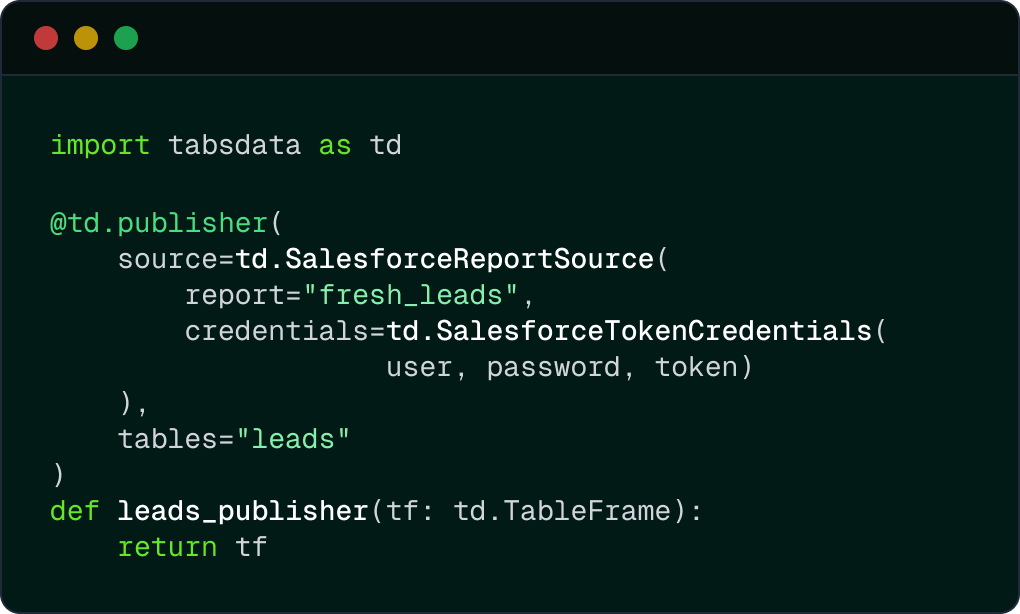
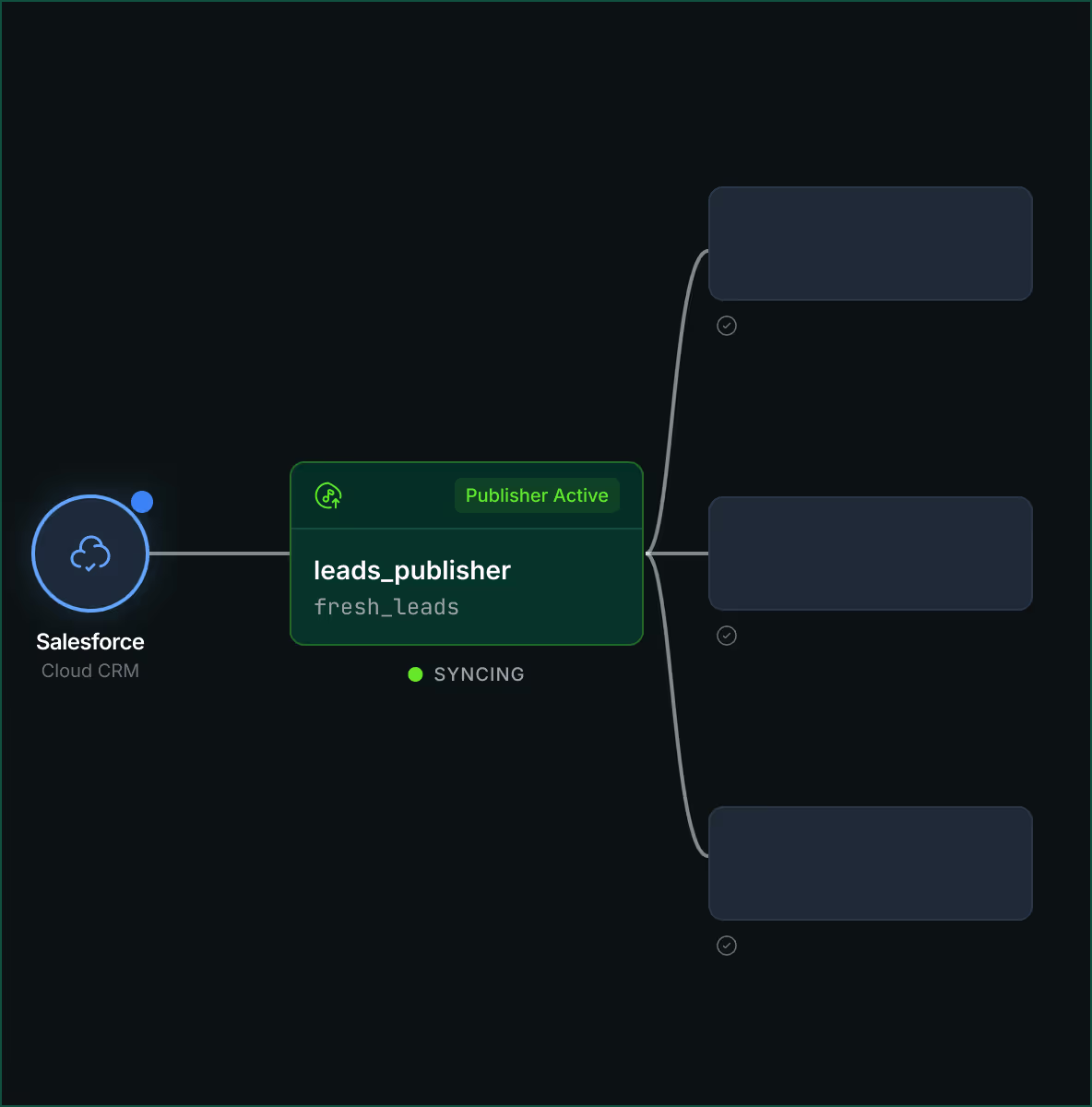
The following example shows how Tabsdata connects to Salesforce, publishes a CRM object as a versioned table, and propagates updates automatically to a downstream system. Once configured, changes in Salesforce produce new table versions that flow reliably across the data stack.

Common Use Cases

Sync Salesforce → Data Warehouse in Real Time

Tabsdata propagates Salesforce updates directly into data warehouses without scheduled syncs, ensuring analytics teams always operate on the latest published CRM data.

Unified Customer 360 Across Systems

Customer data remains synchronized across analytics platforms, internal applications, and downstream services, enabling a consistent Customer 360 view without reconciliation or manual stitching.

Real-Time Marketing Activation

Fresh Salesforce data flows automatically into activation tools and analytics systems, allowing marketing teams to respond to lead and account changes without delayed or stale segmentation.

ML-Ready Training Sets

Versioned CRM datasets provide reproducible inputs for machine learning workflows such as churn prediction, lead scoring, and lifetime value modeling.

Compliance & Governance Pipelines

Built-in lineage and version history support compliant reporting and audits by making Salesforce-derived datasets fully traceable across revenue, operations, and regulatory workflows.

About Salesforce

Salesforce is a leading CRM platform used for sales, service, marketing, and customer lifecycle management. Its data model is built around standard and customizable objects that support complex enterprise workflows across customer, revenue, and operational systems.

Start Using Tabsdata + Salesforce

See how Tabsdata delivers in real-time, lineage-backed Salesforce dataflows to your analytics, AI, and operations stack. Explore the documentation or request an integration review to evaluate how Tabsdata simplifies CRM data syncing.

Salesforce Integrations FAQs

  • How does Tabsdata handle Salesforce API limits?

    Tabsdata minimizes API usage by publishing new table versions only when required, rather than relying on constant polling.

  • Does Tabsdata support custom objects?

    Yes. Both standard and custom Salesforce objects can be synced as versioned datasets.

  • Can Tabsdata sync Salesforce → Snowflake/BigQuery/Databricks?

    Yes. Salesforce data can propagate automatically to multiple downstream destinations simultaneously.

  • Does Tabsdata support bidirectional sync?

    Tabsdata focuses on reliable outbound propagation from Salesforce into downstream systems.

  • How does lineage work with Salesforce data?

    Lineage is generated directly from table version propagation, making Salesforce-derived datasets fully traceable.

  • What about schema changes in Salesforce?

    Schema changes create new table versions that propagate with metadata preserved.

  • Can Tabsdata replicate large Salesforce orgs?

    Yes. Tabsdata is designed to scale across enterprise Salesforce environments with millions of records.

  • Can Tabsdata replace CDC or polling-based ETL jobs?

    In many cases, yes. Tabsdata removes the need for polling or CDC pipelines by using deterministic, versioned propagation.