
Real-Time Connector

Tabsdata + Snowflake Integration for Deterministic, Real-Time Dataflows

Integrate Snowflake with Tabsdata to build deterministic, real-time, versioned dataflows without orchestration or brittle pipelines. Using Pub/Sub for Tables, Tabsdata enables deterministic propagation, built-in lineage, and reproducible table states, ensuring Snowflake always receives complete, consistent table versions.

About This Snowflake Integration

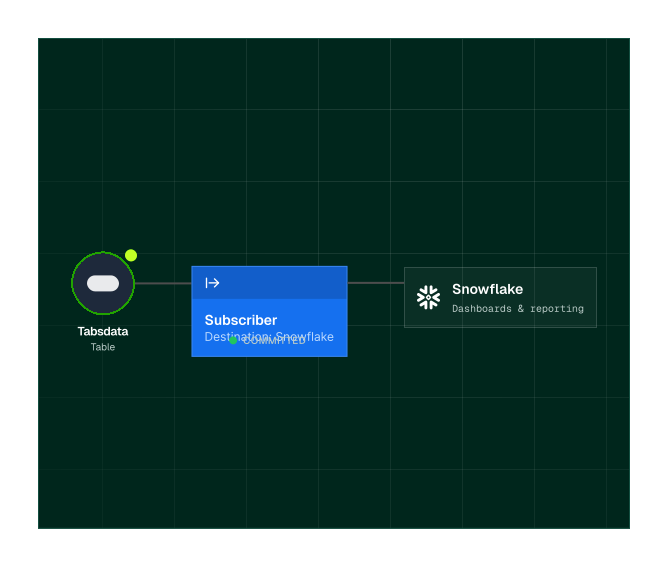
The Tabsdata + Snowflake integration enables connectivity between Tabsdata’s declarative dataflow engine and Snowflake’s cloud data platform. Snowflake tables act as downstream subscribers within the Pub/Sub for Tables model, receiving new immutable table versions automatically.

Rather than relying on scheduled ETL jobs or manual backfills, updates propagate automatically as soon as new table versions are published, based on declared table dependencies. This ensures that data written into Snowflake remains consistent, auditable, and aligned with upstream business logic, without partial refreshes or table-level skew.

Key Capabilities

These capabilities describe how versioned tables, dependency propagation, and native lineage work together to deliver deterministic, real-time Snowflake dataflows without pipeline complexity.

Real-Time Data Propagation into Snowflake

‍When new data is published, a fresh immutable table version is created and automatically propagated to Snowflake through declared dependency relationships. Updates propagate in deterministic order, allowing Snowflake to reflect a consistent data state across related tables without manual coordination.

This avoids scenarios where dashboards, reports, or downstream consumers observe mismatched table states due to asynchronous refresh behavior.

Reproducible, Immutable Table States

All tables delivered into Snowflake represent complete, immutable table versions. These versions preserve historical states by design, enabling reliable replay, debugging, and recomputation. Snowflake consumers can rely on each table representing a complete, version-aligned snapshot rather than a partially updated state.

Automatic Lineage and Metadata Preservation

Lineage and metadata are captured natively as table versions propagate into Snowflake. Because lineage is derived directly from table version relationships, it reflects true upstream inputs, transformations, and dependencies.

Zero Orchestration Required

Tabsdata removes the need for workflow orchestration when integrating with Snowflake. Execution order is inferred automatically from declared table dependencies, ensuring predictable and repeatable propagation into Snowflake.

Works Across Your Entire Stack

Snowflake operates as a single subscriber within a broader, versioned data ecosystem. The same table versions that propagate into Snowflake can also feed machine learning pipelines, dashboards, APIs, and operational systems. This ensures all your downstream consumers will stay aligned on the same consistent data state, rather than drifting due to disconnected pipelines.

Installation

Tabsdata + Snowflake integration is seamless and frictionless, designed specifically to be developer-friendly. Installation can happen directly using pip, with configuration coming via standard connection elements.

$ pip install tabsdata-snowflake

Snowflake’s credentials and target tables are defined into Tabsdata configuration, and allows Snowflake to participate instantly as a versioned dataflow subscriber.

Example Usage

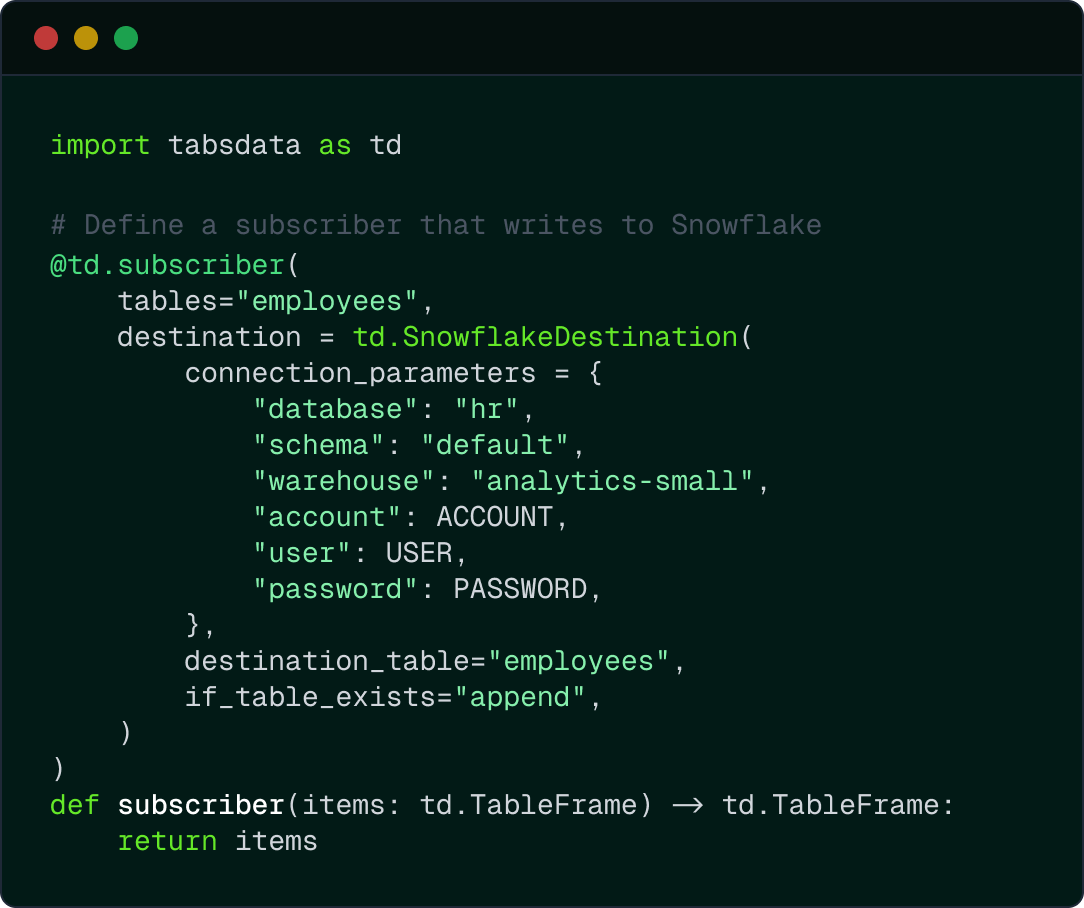
The following example illustrates how data that’s published in Tabsdata can be automatically propagated into Snowflake using versioned tables and dependency subscriptions.

Once configured, every new table version that’s published in Tabsdata is propagated automatically into Snowflake. Updates occur deterministically, with lineage and metadata preserved for each version.

Common Use Cases for Tabsdata + Snowflake

The Tabsdata + Snowflake integration supports a wide range of analytical, operational, and compliance-driven workloads. These use cases highlight how real-time propagation, versioning, and lineage simplify data delivery across Snowflake-powered systems.

Real-Time Analytics & BI

Tabsdata enables Snowflake to receive continuously updated table versions as source data changes. This allows analytics and BI teams to work with fresh, consistent datasets without relying on scheduled refreshes or fragile pipelines.

ML Feature Freshness

Machine learning workflows depend on timely and consistent feature data. With Tabsdata, feature tables propagate into Snowflake automatically as new versions are published upstream. This helps ensure that training and inference pipelines operate on aligned, versioned feature sets, reducing data drift and improving model reliability.

Fraud & Anomaly Detection

Fraud and anomaly detection systems benefit from near real-time access to enriched datasets. Tabsdata propagates updated table versions into Snowflake as events are being processed, allowing detection logic to operate on the latest available data. Deterministic propagation and preserved lineage support investigation, replay, and audit workflows.

Compliance Reporting

Versioned tables and native lineage simplify regulatory and compliance reporting in Snowflake. Each dataset can be traced to its upstream sources and transformations, making it easier to validate reports, reproduce historical results, and demonstrate data provenance during audits. This is achieved without maintaining parallel tracking systems.

About Snowflake

Snowflake is a cloud data platform that is designed for analytics, machine learning, and data-driven applications. It enables organizations to store, process, and analyze large volumes of structured data with scalable performance, strong security controls, and support for real-time workloads across data ecosystems.

Start Using Tabsdata + Snowflake Today

See how Tabsdata delivers real-time lineage-backed dataflows directly into Snowflake without pipelines or orchestration.

Frequently Asked Questions

  • How does Tabsdata publish data into Snowflake?

    Tabsdata publishes immutable table versions and propagates them into Snowflake as subscribed downstream tables through dependency-based execution.

  • How does Tabsdata handle schema changes?

    Schema changes are captured as part of the new table versions, with metadata preserved and propagated downstream, alongside the updated data. 

  • Does this integration replace ETL pipelines?

    For many Snowflake ingestion and preparation use cases, Tabsdata replaces scheduled ETL jobs by propagating complete, versioned table updates automatically through declarative dependencies. 

  • Does Tabsdata support Snowflake Snowpipe / tasks / streams?

    The integration does not rely on Snowpipe tasks or streams. Propagation is handled natively through Tabsdata’s versioned dataflow engine. 

  • Does the integration work in real time?

    Traditional ETL depends on scheduled batch jobs, which makes data slow to update and hard to keep consistent as systems change. Pipelines become brittle over time, breaking when schemas shift or new sources are added, and they require constant maintenance to stay reliable. Because each job runs in isolation, it’s difficult to trace lineage, manage dependencies, or guarantee that the downstream consumers see a consistent, up-to-date view of the data.

  • Is lineage preserved when writing to Snowflake?

    Yes. Lineage is derived directly from table version relationships and remains intact when data is propagated into Snowflake. 

  • What permissions are required?

    Tabsdata requires standard Snowflake permissions for writing tables and managing schema, alongside access credentials defined in the integration configuration. 

  • Can Snowflake be both a source and a destination?

    Yes. Snowflake can act as both a publisher and subscriber, participating bidirectionally in versioned dataflows.