Governance by Design

Data Integrity and Governance as a Consequence of Deterministic Dataflows

When execution is ambiguous, governance becomes an interpretive exercise. Lineage reconstructed from logs and orchestration metadata cannot guarantee reproducibility over time.

Tabsdata approaches data integrity differently. Integrity and governance are not separate systems or optional controls. They are direct consequences of deterministic execution and versioned data state.

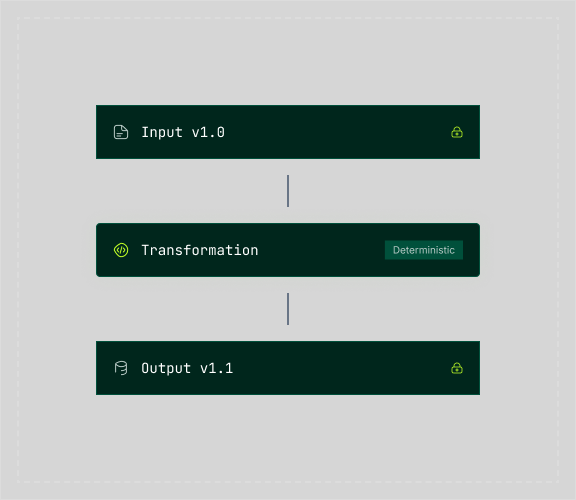
Every transformation runs according to declared dependencies. Every execution produces a new, immutable version of data state. Every result can be traced back to the exact inputs and execution plan that produced it.

Governance is enforced by execution, not by convention or post-processing tools. Integrity is preserved because data state evolves deterministically, not because policies attempt to correct drift after the fact.

This is the foundation of trustworthy analytics, reproducible AI, and audit-ready operations.

Data Integrity & Governance Overview

In Tabsdata, data integrity and governance are properties of the execution model, not features layered on top of it.

Every dataset is represented as an immutable table version, and every transformation executes deterministically on explicit inputs. As a result, outputs can always be reproduced, explained, and validated without relying on external governance tooling or post-hoc analysis.

As table versions are published and propagated through declared dependencies, metadata, lineage, and impact relationships are generated automatically. The system always knows where data originated, how it was transformed, and which downstream consumers were affected by each version.

Benefits of Tabsdata’s Data Integrity & Governance Model

Tabsdata’s data integrity and governance guarantees emerge directly from its deterministic, versioned execution model. These benefits are not configured or enforced manually. They are properties of how dataflows run.

End-to-End Lineage Without Inference

Because lineage is generated directly from table version propagation, every dataset, transformation, and dependency can be traced from source to destination without inference or external tooling. Lineage reflects actual execution, not reconstructed metadata.

Complete Provenance and Version History

Every change produces a new immutable table version, preserving a complete historical record of how data evolved over time. Teams can inspect prior states, understand how results were produced, and explain exactly why a dataset looks the way it does.

Deterministic and Predictable Dataflows

Tabsdata guarantees that the same published inputs always produce the same outputs. Deterministic execution eliminates ambiguity across environments and time, making dataflows predictable, reproducible, and safe to audit.

Faster Incident Resolution and Audits

When issues arise, teams can reproduce historical data states and replay transformations using exact inputs. Audits and investigations no longer require manual reconstruction or guesswork, because lineage, versions, and dependencies are always available.

Consistent Trust Across Analytics and AI

Because data origin, transformation logic, and version history are transparent, analytics and AI teams consume data that proves its own correctness. Dashboards, features, and model inputs are derived from consistent, explainable data states.

Data Integrity-by-Design Architecture

In Tabsdata, data integrity is enforced by the execution model itself.

Dataflows are defined declaratively, and execution order is derived from explicit table dependencies rather than scripts, schedulers, or imperative workflows. This eliminates hidden logic, ad-hoc transformations, and undocumented execution paths that commonly undermine governance in traditional ETL systems.

Every transformation operates on immutable table versions and produces a new version atomically. There are no in-place updates, partial writes, or side effects that can bypass controls or leave data in an inconsistent state.

Because execution is deterministic and fully observable, every data movement, transformation, and dependency can be inspected and validated. Governance does not rely on conventions, naming rules, or manual reviews. Unsafe or non-governed execution paths simply cannot exist within the system.

Data Integrity for AI and Decision Systems

AI and decision systems depend on reproducible data state.

Training datasets, feature generation pipelines, and inference workflows often evolve independently. When data is revised or backfilled, models may no longer align with the state that originally produced their outputs. Explainability becomes dependent on reconstruction rather than preserved execution context.

Tabsdata preserves deterministic, versioned datasets across both training and inference paths.

Each model can be associated with the exact dataset versions and transformation logic used during training. When data changes, new versions are produced explicitly rather than implicitly mutating prior state. Historical training data remains intact and queryable.

Because execution is deterministic, the relationship between data state and model output remains traceable over time. Reproducibility does not depend on replaying pipelines or reconstructing feature history.

For architected AI systems, integrity is not an overlay. It is a property of versioned state transitions.

Data Integrity & Governance by Execution

Integrity and governance in Tabsdata are not configured through external policy engines. They are structural properties of the execution model.

Immutable, Versioned Data State

Every execution produces a new, immutable version of data. Historical state is preserved automatically, making it possible to reproduce any prior result without reconstruction.

Deterministic Execution Plans

Execution order is derived from declared dependencies, not implicit orchestration logic. This ensures that the same inputs always produce the same outputs.

Automatic Lineage Graphs

Lineage is materialized as part of execution, not reconstructed afterward. Every dataset version includes its full dependency graph, including transformation logic and upstream versions.

Transactional Publication

Data is published only when execution completes successfully. Partial updates and inconsistent intermediate states are never exposed to downstream systems.

Time-Consistent Queries

The system can be queried as of a specific point in time, with cross-dataset alignment guaranteed. Historical analysis does not depend on replay or manual reconstruction.

Governance Without Reconstruction

In many data systems, governance depends on reconstructing execution after it completes. Lineage is derived from logs, execution order inferred from orchestration metadata, and historical results reproduced by replaying pipelines.

This reconstruction introduces ambiguity. Logs rarely capture full dependency context, orchestration changes over time, and replay can diverge from original conditions. Auditability becomes an interpretive exercise rather than a structural guarantee.

Tabsdata derives governance directly from execution semantics.

Execution plans are computed deterministically before runtime. Dependencies, dataset versions, and ordering are resolved explicitly. Each successful execution transitions the system atomically from one versioned data state to the next.

Lineage is materialized as part of execution. Historical state is preserved, not replayed. The exact inputs, transformations, and dataset versions that produced a result remain queryable over time.

Because state transitions are explicit and immutable, governance does not require reconstruction. Integrity and auditability follow directly from how the system executes.


Data Integrity & Governance Outcomes

By enforcing governance through deterministic execution, Tabsdata removes many of the failure modes that traditionally undermine data initiatives.

Teams gain the ability to explain exactly how data was produced, which inputs were used, and how results propagated across systems. Audits and investigations rely on execution history rather than manual reconstruction.

Analytics and AI systems consume consistent, version-aligned data states, reducing the risk of silent drift, inconsistent reporting, or unexplainable model behavior.

As data platforms scale and evolve, governance does not degrade. Because controls are embedded in execution rather than layered through policy or process, data integrity and governance remain intact as data volumes, teams, and use cases grow.

Validate Data Integrity and Governance by Execution

Tabsdata embeds security and governance directly into how dataflows execute.

If you want to evaluate how deterministic execution, immutable data versions, and automatic lineage behave in your environment, the best next step is to review Tabsdata in action.

Explore how Tabsdata supports secure, auditable dataflows across analytics, AI, and operational systems without introducing separate governance pipelines.

Frequently Asked Questions

  • How does Tabsdata enforce data governance?

    Tabsdata enforces governance through execution, not policy layers. All dataflows operate on immutable table versions and execute deterministically based on declared dependencies. As a result, lineage, reproducibility, and auditability are guaranteed by how the system runs, not by manual controls or conventions.

  • Is lineage inferred or explicitly tracked?

    Lineage is derived directly from execution. As table versions propagate through declared dependencies, Tabsdata records the exact inputs, transformations, and downstream consumers involved. There is no inference, sampling, or post-processing required.

  • Can historical data states be reproduced exactly?

    Yes. Every table version is immutable and preserved. Any historical state can be inspected or recomputed using the same inputs and transformations that originally produced it, supporting audits, investigations, and long-term reproducibility.

  • How does Tabsdata support audits and compliance reviews?

    Audit evidence is produced directly from execution metadata, including table versions, lineage, and dependency history. Reviews do not require reconstructing pipelines, scripts, or logs. The system itself provides a complete execution record.

  • How are access controls enforced?

    Tabsdata integrates with enterprise identity providers and permission frameworks to control access to tables, transformations, and environments. Access policies apply consistently across execution, lineage, and version history.

  • Does Tabsdata require separate governance pipelines or tools?

    No. Governance does not rely on separate pipelines, scanners, or policy engines. Lineage, versioning, and reproducibility are always active as part of normal execution.

  • How does Tabsdata support AI and ML governance?

    Training datasets, feature tables, and inference inputs are all versioned and reproducible. Lineage connects models back to their source data, making it possible to explain how models were trained and why they produced specific results. AI governance inherits the same guarantees as data governance.

  • Can governance guarantees be bypassed?

    No. Because execution is declarative and deterministic, unsafe or undocumented execution paths cannot exist within the system. All transformations and dependencies are explicitly declared and enforced by the execution engine.

  • Where does Tabsdata run, and how is data isolated?

    Tabsdata runs inside customer-controlled infrastructure, such as private cloud or VPC environments. All data processing, versioning, and propagation occur within approved security boundaries.

  • Does Tabsdata support regulated environments?

    Tabsdata is designed to support regulated environments by providing deterministic execution, immutable versioning, and full traceability. Compliance depends on deployment configuration and operational controls, but the architecture supports common regulatory requirements by design.

  • How does Tabsdata reduce operational risk?

    By eliminating non-deterministic pipelines, hidden scripts, and partial updates, Tabsdata removes many common failure modes that lead to data inconsistencies, audit gaps, and security incidents.