Clear Visibility Across Complex Dataflows
Lineage spans batch, CDC, and real-time updates in a single unified model.
Modern data systems are increasingly real time, interconnected, and difficult to reason about. When something breaks, teams need to know exactly what data changed, where it came from, how it was transformed, and which downstream systems were affected.
Tabsdata provides execution-native data lineage. Every dataset version, transformation version, and dependency is captured automatically as part of how data flows through the system. Lineage is complete, reproducible, and reflects the exact state of data at any point in time.

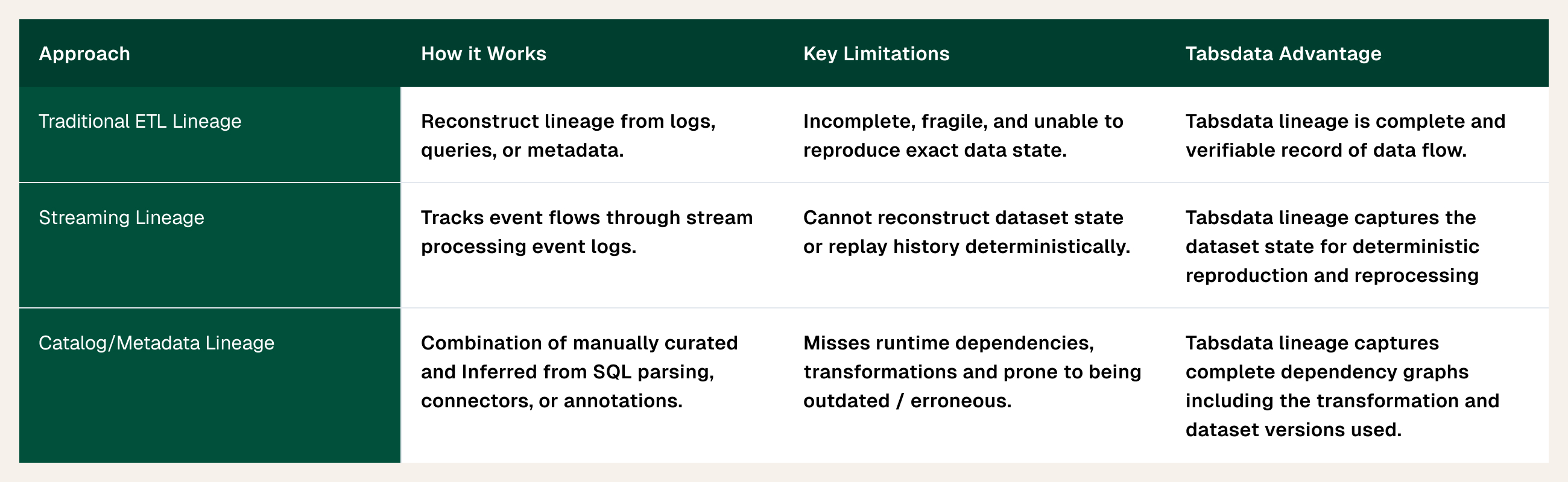
Most data lineage solutions attempt to reconstruct lineage after the fact. They rely on logs, query plans, SQL parsing, or metadata crawlers to infer how data might have moved through pipelines.
This approach breaks down quickly in real systems:

Logs capture execution steps, not exact data state

Streaming systems process events, not reproducible datasets

Backfills and reprocessing mutate history

Hybrid batch and streaming stacks fragment context
The result is lineage that looks plausible but cannot answer the questions engineers actually care about. When systems fail, inferred lineage is not enough.
Lineage in Tabsdata exists because of how the platform operates.
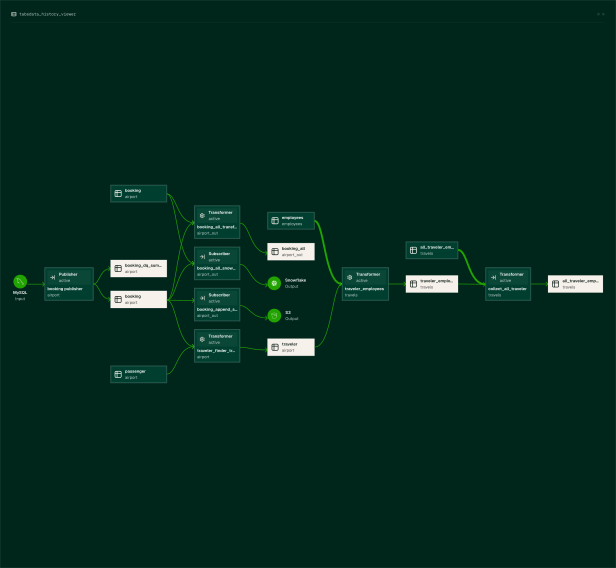
Teams define datasets and relationships. Tabsdata computes and maintains the full dependency graph automatically and keeps it up to date as data and logic change.
The same inputs always produce the same outputs. This guarantees that lineage is stable and consistent across environments.
Every update creates a new, immutable table version. Historical states are never overwritten or lost.
Most lineage tools can show structure. Tabsdata enables replay.
When an issue occurs, teams can:

Identify the exact upstream change that triggered it

Inspect intermediate dataset states

Reproduce the system state at any moment in time
This turns debugging from a forensic exercise into a deterministic workflow.
For complex transformations, late-arriving data, or real-time ETL pipelines, this capability is essential.

In traditional systems, reprocessing and backfills often break lineage. Jobs are rerun, streams are replayed, and historical context becomes inconsistent or incomplete. With Tabsdata:

Corrections trigger declarative recomputation

Affected datasets update deterministically

All historical versions remain available
Lineage remains intact before, during, and after reprocessing. Engineers can reason about change safely, without fear of corrupting history.
In real-time ETL and ML feature pipelines, understanding historical state is critical. Tabsdata makes it possible to:

Trace how features were computed at a specific moment

Reproduce exact training or inference inputs

Debug unexpected model behavior long after deployment
This level of lineage is only possible when execution, state, and propagation are all deterministic.

With Tabsdata, lineage updates the moment data changes. Engineers can explore dependency graphs, inspect dataset versions, and reproduce historical states without manual instrumentation or maintenance.
Can’t find the answer you’re looking for? Please chat to our friendly team.