Deterministic Ecommerce Data

Deterministic Real-Time Data Integration for Ecommerce.

Ecommerce systems change continuously—orders are placed, inventory moves, prices update, and customer behavior shifts in real time. When data propagation is inconsistent, teams end up operating on conflicting views of the business.

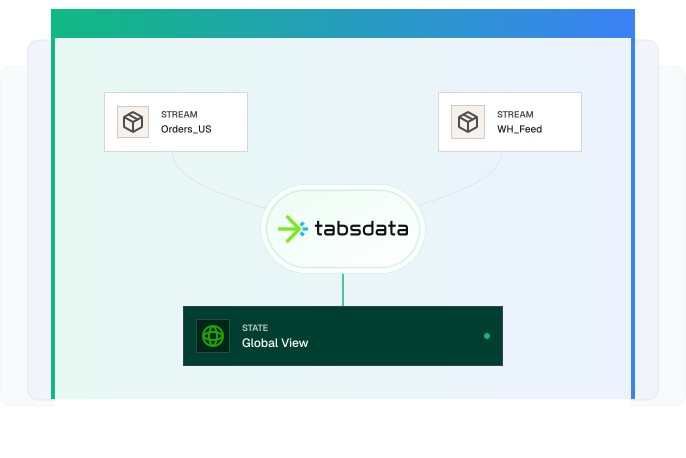
Tabsdata is a deterministic real-time data integration system designed to keep operational and analytical systems aligned as data changes. By executing dataflows on immutable datasets with explicit dependencies, Tabsdata ensures every system observes the same versioned state upon publication.

This allows ecommerce teams to power inventory, pricing, personalization, and analytics workflows in real time without reconciliation logic, lagging dashboards, or silent inconsistencies.

Why Real-Time Data Breaks at Scale

Why Real-Time Data Breaks at Scale

Ecommerce operations depend on multiple systems reacting to change at the same time. Orders, inventory, pricing, promotions, and customer behavior all evolve continuously, often across dozens of services and data stores.

Most real-time data architectures struggle under this level of change. Many real-time data architectures propagate updates incrementally, creating partial states where different systems observe different versions of the business at the same moment. Inventory systems lag order systems, pricing diverges from promotions, and analytics trails operations.

As scale increases, teams compensate with reconciliation jobs, safety buffers, and manual overrides. These compensations reduce velocity and still fail to eliminate inconsistencies. The problem is not a lack of real-time infrastructure. It is the absence of deterministic propagation and complete, versioned data states.

Without determinism, real-time data amplifies operational risk. Overselling, incorrect pricing, broken personalization, and conflicting dashboards become normal failure modes rather than exceptions.

What Changes When Ecommerce Dataflows Are Deterministic

What Changes When Ecommerce Dataflows Are Deterministic

When ecommerce dataflows execute deterministically, systems no longer react to partial or out-of-order updates. Every downstream consumer observes the same complete, versioned state of the business when new data is published.

Inventory, orders, pricing, promotions, and customer data remain aligned across operational and analytical systems. Teams no longer need reconciliation logic or safety buffers to compensate for inconsistent propagation.

Because data states are complete and reproducible, analytics and operational systems stay in sync. Dashboards reflect what actually happened, not approximations assembled after the fact. Decisions based on inventory levels, pricing changes, or customer behavior are made against coherent data snapshots rather than drifting views.

As scale increases and change accelerates, real-time data becomes a source of reliability instead of risk. Ecommerce teams gain the ability to operate continuously without trading correctness for speed.

Tabsdata’s Approach to Ecommerce Data Integration

Tabsdata approaches ecommerce data integration from first principles: operational systems and analytics must observe the same state of the business as data changes.

Deterministic Propagation of Business State

Dataflows in Tabsdata are defined declaratively and operate on immutable datasets. Each time data is published, the full dependency graph is evaluated and executed in a deterministic order, ensuring downstream systems receive complete, version-aligned data states rather than partial updates in transit.

No Pipelines or Event Choreography

Execution order is derived directly from declared dependencies, not from imperative pipelines, schedulers, or event choreography. This removes hidden execution paths and non-deterministic behavior that commonly lead to inconsistent inventory counts, pricing discrepancies, and delayed analytics in ecommerce systems.

Consistent Operations and Analytics

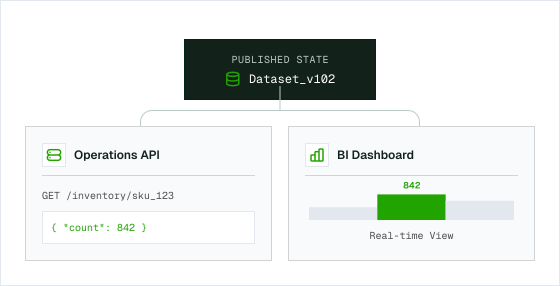
Because every dataset version is preserved, operational and analytical systems consume the same versioned data states. Teams no longer reconcile dashboards against operational systems or debug discrepancies caused by timing and propagation gaps.

Reproducibility Across Change

As catalogs evolve, pricing rules change, and customer behavior shifts, historical data states remain reproducible. Teams can understand exactly what the business looked like at any point in time, even as systems and logic evolve.

Ecommerce Use Cases

When ecommerce dataflows are deterministic, operational and analytical systems act on the same versioned state of the business. This reduces common sources of inconsistency across inventory, pricing, customer experience, and analytics as data changes in real time.

Real-Time Inventory Visibility

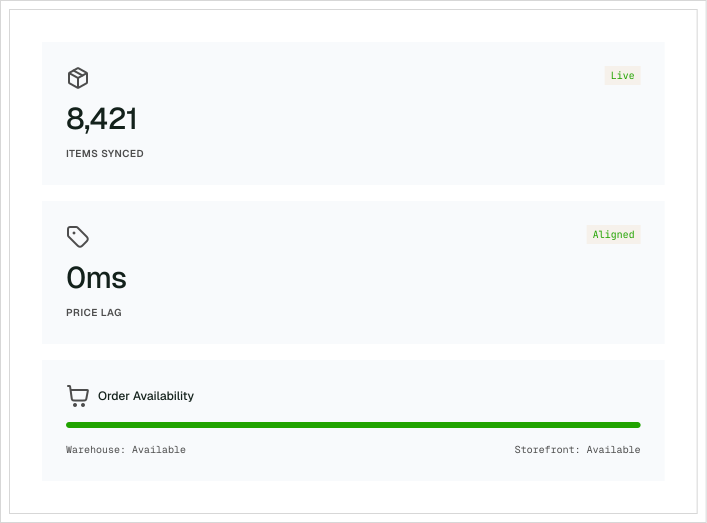
Inventory systems depend on accurate, up-to-date views of stock across warehouses, channels, and fulfillment partners. Deterministic propagation ensures inventory updates are applied as complete states, preventing overselling and reducing the need for safety buffers and manual overrides.

Dynamic Pricing and Promotions

Pricing and promotions change frequently and often depend on multiple upstream signals. Version-aligned data states ensure pricing engines, storefronts, and downstream analytics observe the same inputs, avoiding discrepancies between advertised prices, applied discounts, and reported revenue.

Personalized Customer Experiences

Personalization systems rely on timely and consistent customer and behavioral data. Deterministic execution ensures recommendation engines, experimentation platforms, and analytics operate on the same data states, reducing inconsistencies between customer experiences and measured outcomes.

Order Lifecycle and Fulfillment Tracking

Orders pass through multiple systems from placement to fulfillment. Consistent data propagation keeps order state aligned across commerce platforms, logistics systems, and customer support tools, improving visibility and reducing downstream reconciliation.

Marketing Performance Analytics

Marketing teams require accurate attribution and performance metrics as campaigns run. Deterministic dataflows keep operational events and analytical datasets aligned, ensuring dashboards reflect actual outcomes rather than delayed or reconstructed views.

Fraud and Anomaly Detection

Fraud detection depends on accurate sequences of transactional and behavioral data. Reproducible, versioned data states allow detection systems to operate in real time while preserving the ability to investigate anomalies against exact historical inputs.

Operating Analytics and Operations on the Same Data

Ecommerce teams often separate operational systems from analytics to avoid latency and consistency issues. As a result, dashboards lag reality, and operational decisions are made using incomplete or reconstructed data.

With deterministic execution and versioned datasets, Tabsdata allows operational workflows and analytics to run on the same published data states. Inventory systems, pricing engines, and customer-facing applications consume the same version-aligned datasets as reporting and analytics tools.

This removes the need for dual pipelines or delayed analytical copies. Teams can analyze what is happening now using the same data that is driving operations, without introducing reconciliation gaps or conflicting views of the business.

As data changes continuously, operational decisions and analytical insights remain aligned by construction rather than coordination.

Security and Reliability at Ecommerce Scale

Ecommerce systems operate continuously and tolerate little margin for error. Data integration failures surface immediately as lost revenue, broken customer experiences, or operational disruption.

Tabsdata enforces reliability by ensuring each published data state is complete and versioned. Each published data state is complete and versioned, eliminating partial writes, inconsistent updates, and hidden side effects that commonly cause downstream failures.

Because execution is derived from explicit dependencies, data propagation is predictable and observable. Teams can understand how changes flow through inventory, pricing, fulfillment, and analytics systems without relying on ad-hoc monitoring or manual intervention.

Tabsdata runs within customer-controlled infrastructure, including private cloud and VPC environments. Data remains within approved boundaries while operational guarantees remain intact as scale and change increase.

Evaluate Deterministic Data Integration for Ecommerce

Ecommerce teams adopt Tabsdata to keep operational and analytical systems aligned as data changes continuously, not to introduce new integration risk.

If you want to evaluate how deterministic execution, immutable datasets, and dependency-driven propagation behave in your environment, the best next step is to review Tabsdata in action.

See how Tabsdata supports real-time inventory, pricing, personalization, and analytics workflows without reconciliation logic or conflicting views of the business.

Frequently asked questions

  • How does Tabsdata differ from real-time streaming or event-driven systems?

    Tabsdata propagates complete, versioned data states deterministically rather than incrementally processing events. This ensures downstream systems observe consistent views of the business instead of partial or out-of-order updates.

  • Does Tabsdata replace my ecommerce platform, warehouse, or analytics tools?

    No. Tabsdata operates as a real-time data integration system. It publishes consistent, version-aligned datasets into existing ecommerce platforms, operational systems, and analytics tools.

  • Can Tabsdata reproduce past data states exactly?

    Tabsdata supports compliance by preserving ownership metadata, transformation context, and complete version history.

  • Can operational systems and analytics safely use the same data?

    Yes. Tabsdata allows operational and analytical systems to consume the same published data states. This eliminates the need for separate pipelines or delayed analytical copies while preserving correctness.

  • How does Tabsdata handle frequent changes in catalogs, pricing, and promotions?

    Each change produces a new dataset version. Downstream systems consume version-aligned states, while historical versions remain available for inspection and analysis.

  • Is Tabsdata suitable for high-traffic ecommerce environments?

    Yes. Tabsdata is designed to operate continuously under high change rates. Deterministic execution ensures reliability as scale and complexity increase.

  • How does Tabsdata support personalization and experimentation?

    Personalization and experimentation systems operate on consistent customer and behavioral data states. This reduces discrepancies between user experiences and measured outcomes.

  • Where does Tabsdata run?

    Tabsdata runs inside customer-controlled infrastructure, including private cloud and VPC environments. Data remains within approved operational boundaries.

  • Does Tabsdata support fraud and anomaly detection?

    Yes. Versioned and reproducible data states allow fraud detection systems to operate in real time while preserving the ability to investigate anomalies against exact historical inputs.

  • What happens when data pipelines fail or upstream systems change?

    Because execution is dependency-driven and deterministic, failures are localized and observable. Changes result in new dataset versions rather than inconsistent downstream states.

  • Still have questions?

    Can’t find the answer you’re looking for? Please chat to our friendly team.